
US President Donald Trump’s Middle East envoy, Jared Kushner, held rare, high-level talks with a Hamas delegation in Egypt on Sunday 17 August, as the US administration intensifies its push to implement the stalled Gaza peace plan. The meetings mark a significant diplomatic manoeuvre aimed at salvaging a sweeping US-backed initiative designed to demilitarise the Palestinian territory and establish a new civilian government.
A Palestinian official confirmed that Kushner met with a Hamas delegation led by the group’s new leader, Khalil al-Hayya. The talks are reportedly the highest-level direct engagement of their kind since a landmark ceasefire agreement for the Gaza Strip took effect late last year. According to regional reports, Kushner was joined by Nickolay Mladenov, Director-General of the US-created international “Board of Peace,” and former UK Prime Minister Tony Blair. Representatives from key mediating nations, Egypt, Qatar, and Turkey, were also present.
Whilst no official statement was immediately released, sources familiar with the discussions indicate the primary focus was translating the Board of Peace’s ambitious 15-point roadmap into verifiable, concrete actions. The framework requires the complete disarmament of Hamas and the decommissioning of its militant infrastructure, followed by a phased withdrawal of Israeli troops and a massive humanitarian reconstruction effort under a new, technocratic Palestinian administration.
A Standoff Over Sequencing
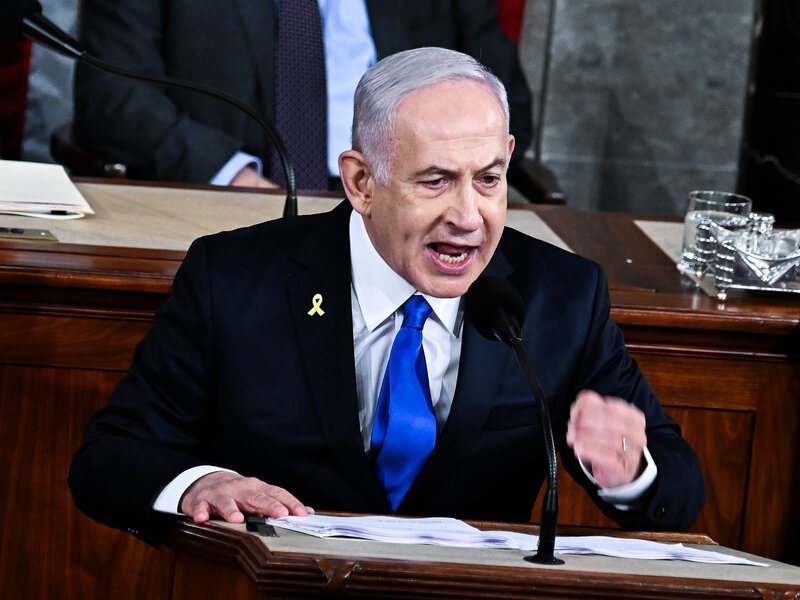
The urgency of Sunday’s meetings in Cairo follows a major diplomatic rupture last week when Israeli Prime Minister Benjamin Netanyahu publicly rejected the 15-point proposal. In a rare public break with Israel’s closest ally, Netanyahu defied the Trump administration’s sequencing of the plan.
“Israel rejects the Board of Peace’s 15-point document on Gaza. The IDF will not carry out any withdrawal until Hamas is genuinely disarmed.”
Israeli Prime Minister Benjamin Netanyahu
The Israeli government’s insistence that complete disarmament must precede any military withdrawal threatens to unravel the delicate multilateral arrangement. In response to Israel’s rejection, a coalition of the eight Muslim-majority nations credited with pressuring the US administration to act on Gaza, Egypt, the United Arab Emirates, Qatar, Saudi Arabia, Jordan, Turkey, Pakistan, and Indonesia, issued a joint statement on Sunday condemning Netanyahu’s stance and warning that it severely threatens Trump’s international efforts for peace.
Netanyahu’s public rejection of the 15-point roadmap and Kushner’s meeting with Hamas represents a stark and highly unusual rupture between the Israeli Prime Minister and his closest ally, President Donald Trump. By openly defying the US-backed plan, Netanyahu has stalled the diplomatic momentum and forced the Trump administration into the position of negotiating directly with Hamas whilst simultaneously pressuring Israel to accept a blueprint it views as a threat to its national security.
The downward spiral of Israel’s Foreign Relationships
Trump currently leads the Board of Peace, an international organisation originally established to broker peace in Gaza before expanding its mandate to address wider global conflicts. Last month, the board announced it had reached a “historic agreement” for the total disarmament of armed factions in the enclave. Hamas’ acceptance of the Trump-brokered disarmament agreement places Israel in a political disaster, as its allies now expect it to fulfil its half of the peace plan, something the Israeli administration never sincerely wanted to do. This is highlighted also by numerous statements by Britain’s new Foreign Secretary, Ed Miliband, showing a fractured relationship between Britain and Israel, triggered by Israel’s outright refusal to implement the two-state solution. In a statement on 19 August, Miliband stated:
“The Israeli Government’s launch of tenders for the E1 settlement project is unacceptable and destructive. Britain will not stand back and accept the destruction of the two state solution.”
The Rt Hon. Ed Miliband MP [Foreign Secretary – The United Kingdom]
The statement drew backlash from Israel’s Foreign Minister who claimed Miliband’s statement was “one-sided”. In a retaliatory statement, the Minister stated:
“I reject outright the statement of the UK Foreign Secretary and the patronising tone of his words… The UK Government’s decision to damage the relationship between our countries is deeply unfortunate.
Israeli Foreign Minister – Gideon Sa’ar
The exchange is emblematic of a broader and accelerating fracture in UK-Israel relations. Britain barred Israeli government officials from attending the DSEI UK 2025 arms fair and previously suspended some arms export licences for weapons that could be used in Gaza. The UK has also sanctioned two senior Israeli cabinet ministers, Itamar Ben-Gvir and Bezalel Smotrich, banning them from entering Britain and freezing their UK assets, a move Israeli officials compared to appeasing the Nazis and that drew sharp criticism from US Secretary of State Marco Rubio. The E1 settlement statement represents the latest escalation in a relationship that has deteriorated markedly since the beginning of the Gaza conflict.
The Humanitarian Crisis
The broader backdrop of these diplomatic negotiations remains one of immense devastation. A ceasefire brokered on 10 October of last year officially remains in place, though the truce has been highly fragile. The Israel Defence Forces (IDF) have not ceased their aggression in the territory since the ceasefire, having conducted several strikes since the agreement, most recently targeting the Khan Yunis and Nuseirat areas, accusing Hamas of violating the terms of the pause.
The scale of the humanitarian catastrophe in Gaza is without modern precedent in the region. The territory’s health ministry reports a death toll exceeding 75,000 Palestinians, though observers, including the United Nations, note the actual figure is likely considerably higher, as entire families have been killed and thousands remain buried under rubble with no prospect of recovery. The systematic destruction of Gaza’s civilian infrastructure has been total in many areas: hospitals have been rendered non-functional, schools destroyed, and water and sanitation systems obliterated. The United Nations Office for the Coordination of Humanitarian Affairs (OCHA) has described conditions in parts of the territory as among the worst it has documented anywhere in the world.
Approximately 1.9 million people have been displaced, accounting for over 90 per cent of Gaza’s pre-war population, many of them multiple times over as successive military operations have rendered each designated safe zone untenable. The World Food Programme has warned that famine conditions are not merely imminent but already present in northern Gaza, where food access has been almost entirely severed. Acute malnutrition among children has reached levels that medical organisations describe as catastrophic, with UNICEF reporting that hundreds of thousands of children are at risk of severe acute malnutrition. Waterborne disease, including hepatitis A and cholera, is spreading rapidly through overcrowded displacement sites where access to clean water has collapsed. Medical supplies are critically depleted, and the few functioning health facilities are overwhelmed, operating without anaesthesia, antibiotics, or the ability to manage the volume of casualties presenting daily.
For the millions trapped in Gaza, debates over disarmament timelines and sequencing frameworks mean little against the daily reality of searching for food, water, and shelter. The humanitarian situation has reached a point where, regardless of the political outcome of the current negotiations, a massive, sustained, and unconditional aid operation is required immediately. The rapid implementation of a lasting, comprehensive peace is not merely a diplomatic objective. For Gaza’s surviving population, it is an existential necessity.