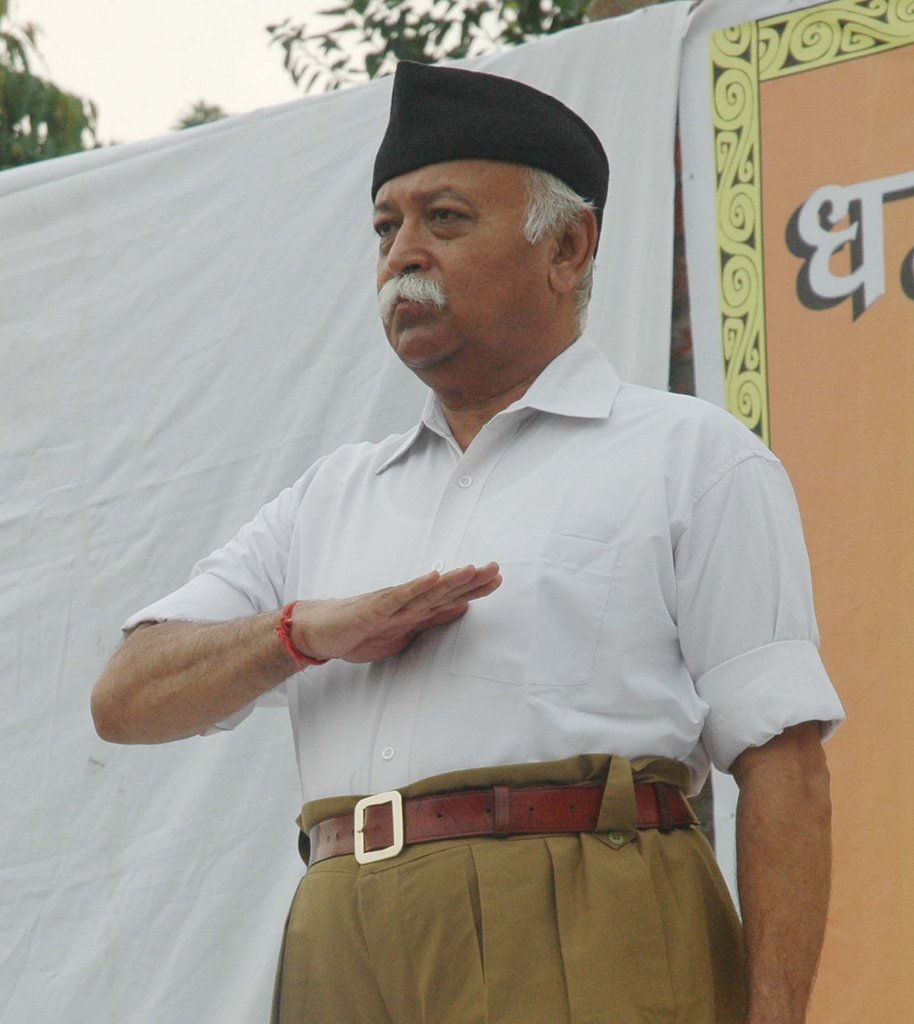
The diplomatic standoff between Washington’s independent monitoring mechanisms, local US political leadership, and New Delhi’s foreign policy apparatus reached an unprecedented threshold as Rashtriya Swayamsevak Sangh (RSS) Chief (Sarsanghchalak) Mohan Bhagwat commenced his multi-nation tour across the United States, Canada, and the United Kingdom. Centred on a 29 August address at New York’s Madison Square Garden for the “Universal Oneness Celebration” hosted by the AHEAD Forum, the visit has drawn severe scrutiny from civil rights groups, municipal leadership, and federal oversight panels.
On 25 August 2026, the Indian American Muslim Council (IAMC) and allied community and faith organisations held a press conference in New York to protest against the upcoming event. Held under the banner “No Platform for Hate,” the protest brought together representatives of Muslim, Hindu, Sikh, Christian, Dalit, and interfaith organisations, reflecting the breadth of opposition to Bhagwat’s appearance on US soil.
The US Commission on International Religious Freedom (USCIRF), a bipartisan federal advisory body created by the US Congress, issued an explicit call for targeted financial asset freezes and visa entry bans against RSS members responsible for severe violations of freedom of religion. Directing its recommendation at the US State Department, USCIRF urged Washington to deny visiting RSS leaders high-level meetings or diplomatic courtesies.
Amplifying this pressure, New York City Mayor Zohran Mamdani publicly voiced deep opposition to Bhagwat’s Madison Square Garden appearance. Speaking at a press conference outside City Hall alongside interfaith coalitions including Hindus for Human Rights and the Indian American Muslim Council, Mamdani, the city’s first Indian-American mayor, stated that whilst municipal authorities lack legal jurisdiction to cancel private bookings at the venue, he strongly opposes the gathering. Mamdani contrasted the secular, pluralistic India of his heritage with the RSS’s exclusionary trajectory, warning against platforming majoritarian figures under the guise of cultural unity. In response, groups such as HinduPACT condemned USCIRF and local officials, accusing them of furthering anti-Hindu narratives and delegitimising diaspora cultural events.
USCIRF Documentation: Systemic Persecution of Minority Communities
USCIRF’s intervention stems from extensive field documentation detailing a degradation of religious freedom across India. The panel’s assessment rejects the framework of isolated communal friction, arguing instead that systemic hostility towards non-Hindu populations has been normalised through majoritarian political organising and state impunity.
- Targeting of Muslim Communities: USCIRF reports highlight a sharp rise in vigilante attacks against India’s 200 million Muslims. The panel emphasises the systemic use of extrajudicial “bulldozer justice,” the administrative demolition of Muslim homes, businesses, and places of worship using heavy machinery following political dissent or communal friction.
- Violent Attacks on Christians: Rights monitors cited by the commission recorded over 1,500 distinct instances of violence, harassment, and service interruptions against Christian congregations in recent reporting cycles, largely driven by local vigilante networks under the pretext of halting forced conversions.
- Marginalisation of Dalits and Sikhs: The panel documents how majoritarian enforcement impacts wider social groups. Dalits attempting to exit traditional caste hierarchies face social boycotts and violent enforcement, whilst Sikh political advocacy and diaspora activism face systematic framing as national security threats.
Legislative Statutes as Instruments of Exclusion
USCIRF’s policy analysis identifies three key statutory domains weaponised to institutionalise minority exclusion:
- The Citizenship Amendment Act (CAA) and NRC: The implementation of statutory rules pairing the CAA with proposed national registration frameworks creates an explicit religious test for expedited citizenship, leaving resident Muslim populations uniquely vulnerable to statelessness and arbitrary detention.
- State Anti-Conversion Statutes: “Freedom of Religion” acts across major states feature altered burdens of proof that enable local law enforcement to detain interfaith couples, Christian clergy, and charitable workers based on unverified third-party complaints.
- Cattle Protection Laws: Anti-cow slaughter regulations across multiple jurisdictions have disrupted minority-dominated livelihoods in the meat export and leather trade, whilst providing administrative impunity to armed extrajudicial cattle vigilante networks (gau rakshaks).
The International Engine: RSS, HSS, and Global Parallels
A critical dimension of USCIRF’s assessment and wider academic scrutiny focuses on the scale and organisational framework of the RSS and its international wing, the Hindu Swayamsevak Sangh (HSS).
The World’s Most Organised Cadre Structure
Formed in 1925, the RSS operates as a massive, uniformed cadre organisation with an estimated 5 to 6 million active members across more than 60,000 daily local branches (shakhas) in India. Its structural discipline, featuring physical training, staff drills (lathi), uniforms, and hierarchical obedience, has led international observers, sociologists, and political analysts to characterise the RSS as the world’s largest non-state organised militia network.
The Role of the HSS Overseas
Operating across more than 40 countries, including over 250 branches in the United States, the HSS functions as the international counterpart of the RSS. Whilst the HSS formally registers as an independent cultural and charitable non-profit, watchdog organisations highlight how it replicates the RSS’s internal organisational structure, leadership hierarchy, and ideological curriculum.
Human rights groups argue that the HSS plays a critical role in soft-power outreach, civic engagement, and political fundraising abroad. This international apparatus is frequently accused of engaging in “pluralism laundering,” using charitable works, interfaith dialogues, and civic receptions, such as tying Rakhi bands on local US law enforcement officers, to normalise the broader movement whilst deflecting international criticism away from domestic human rights violations in India.
Core Drivers Behind the Call to Ban and Sanction RSS Leadership
USCIRF leadership, including Chair Asif Mahmood and Commissioner Gene Mills, based their demand for sanctions and diplomatic isolation on several specific structural points:
- Ideological Fountainhead Status: The RSS serves as the ideological parent organisation of the ruling Bharatiya Janata Party (BJP). Top political figures, including Prime Minister Narendra Modi, were trained within the RSS cadre. USCIRF contends that the leadership cannot claim credit for democratic achievements whilst disclaiming moral or structural responsibility for majoritarian policies executed by its political wing.
- Affiliate Field Operations: Subgroups within the broader Sangh Parivar umbrella network, including the Vishva Hindu Parishad (VHP) and Bajrang Dal, have been directly linked by international monitors to field-level mob violence, violent anti-conversion campaigns, and minority intimidation. Sanctioning RSS leadership strikes directly at the organisational nexus of this network.
- Challenging Overseas Soft Power: Former USCIRF officials argue that high-profile global speeches by RSS leaders are calculated efforts to project an image of global harmony abroad whilst advancing majoritarian policies domestically. USCIRF commissioners argue that visiting leaders should answer directly to documented human rights violations rather than receiving unexamined public platforms.
Strategic Tension and Foreign Policy Trade-Offs
India’s Ministry of External Affairs (MEA) has repeatedly rejected USCIRF’s assessments, dismissing the commission as a “biased entity with a political agenda” that relies on selective narratives. New Delhi maintains that its constitutional framework guarantees equal protection under the law for all citizens, whilst highlighting incidents of anti-Hindu hate crimes and temple vandalism in Western countries.
Because USCIRF operates strictly as an independent congressional advisory body, its recommendations under the International Religious Freedom Act (IRFA) are non-binding on the US Department of State. Executive foreign policy frequently balances human rights mandates against hard-power strategic imperatives in the Indo-Pacific, where India remains a central counterweight and trade partner.
However, as local leaders like Mayor Zohran Mamdani join federal bodies like USCIRF in challenging the presence of RSS leadership on US soil, Washington faces intensifying friction between its supposed values-based diplomatic posture and realpolitik strategic alliances.
USCIRF’s full recommendations can be read at: uscirf.gov