
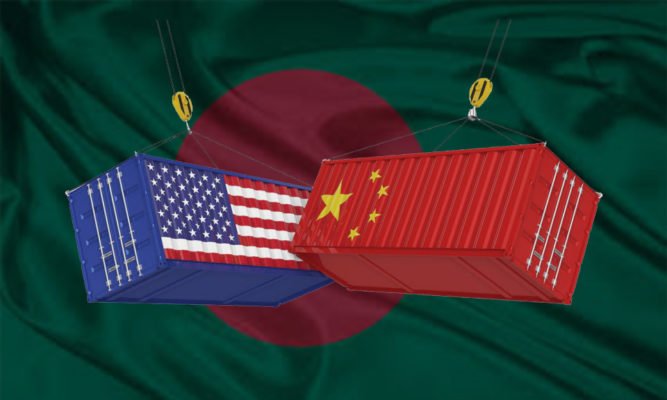
Seven months into Tarique Rahman’s premiership, the clearest illustration of where things stand arrived not from a communiqué but from a press briefing.
On 25 August, Zahed Ur Rahman, the prime minister’s information and broadcasting adviser, said the relevant Bangladeshi procurement committees had prepared draft agreements concerning J-10CE multirole fighters and attack helicopters, which were being circulated to the Armed Forces Division and other ministries for approval. The documents are intended to underpin further engagement with China, not a publicly announced final purchase contract.
A report citing an Armed Forces Division document has put the prospective J-10CE package at 20 aircraft and about $2.302 billion, but Dhaka has not publicly announced binding terms on quantity, price, financing, delivery schedule or signature date.
Three weeks earlier, on 4 August, Rahman met US Pacific Fleet commander Admiral Stephen Koehler, where the General Security of Military Information Agreement was discussed; neither a GSOMIA signing nor a conclusion on the long-pending Acquisition and Cross-Servicing Agreement was announced.
Set side by side, the two data points still capture something real, even if neither is quite as settled as it first appears: China is moving faster from political signalling into project and procurement preparation. Washington is still trying to convert broad strategic intent into signed defence frameworks it first proposed in 2019.
That contrast would have seemed unlikely on ideological grounds alone. The Bangladesh Nationalist Party has long been read, in Dhaka and in Delhi, as the more Western-leaning of the country’s two major parties, more comfortable with Washington and Islamabad than the India-tilted Awami League it replaced.
But Rahman’s own itinerary told a different story from the outset. His first foreign trip after taking oath on 17 February, following a landslide that gave the BNP a two-thirds majority, began in Kuala Lumpur and continued to Beijing — not to Washington, and not to Delhi, where he has so far been invited on multiple occasions.
What Beijing actually delivered
Rahman’s China visit ran from 22 to 26 June. Bangladeshi reporting puts the total at 17 cooperation documents, including a memorandum signed not between the two governments but between the BNP and the Chinese Communist Party — a small detail that says a great deal about how deliberately Beijing has cultivated Bangladesh’s political class across the divide, courting the Awami League, the interim administration and the BNP in turn since 2024.
China’s own official language was less granular, describing “a number of cooperation documents” rather than itemising them. The two sides agreed, per the joint communiqué, to elevate their relationship to a “China-Bangladesh community with a shared future in the new era.”
On the Teesta River Comprehensive Management and Restoration Project — the long-delayed scheme Sheikh Hasina had courted Delhi over for a decade — Beijing’s commitment, as stated in the communiqué, is to provide support “within its capacity” and to help expedite the feasibility study.
That is politically significant, but it stops short of a construction or financing commitment; it is an early-stage pledge, not evidence the project has been secured. The two governments also agreed to advance the Mongla Port Facilities Modernization and Expansion Project and a Chinese Economic and Industrial Zone at Chattogram.
None of this is entirely new. China has supplied the bulk of Bangladesh’s arms imports for over a decade, and Dhaka and Beijing signed a UAV manufacturing agreement in January this year, with a drone-production facility expected to become operational later in the year — reporting on its exact location has been inconsistent.
The J-10CE talks are an acceleration of that relationship rather than a departure from it. But a draft negotiating paper is not a delivered squadron: fighter procurements of this scale typically involve multi-year timelines from signature to induction, shaped by financing, production slots and training pipelines, so what China has secured so far is Dhaka’s intent to negotiate, not yet its air force.
What Washington is holding out for
The Agreement on Reciprocal Trade that the Yunus interim government signed on 9 February, days before the election, set a US tariff on Bangladeshi goods of no higher than 19 percent — one point below the 20 percent rate then in effect, and well below the 37 percent rate first floated in April last year.
The agreement is not a simple, permanent fix: it ties the rate to an executive-order framework that allows Washington to reimpose higher tariffs after a finding of noncompliance, and it extracts far broader commitments than trade numbers alone suggest — on vehicle and pharmaceutical standards, digital policy, data flows, export controls, sanctions cooperation, investment transparency and specified US purchases.
One provision allows the US to terminate the pact if Bangladesh enters a preferential economic agreement with a “non-market economy” that undermines the deal and consultations fail — a conditional clause, not a blanket prohibition on dealing with China.
Trump’s congratulatory letter to Rahman, sent the day after his swearing-in, urged him to complete the long-discussed defence agreements alongside the trade relationship. The two tracks are clearly related in US strategy, even if the public record doesn’t establish a formal, stated quid pro quo between them.
Eleven days after the trade agreement was signed, the US Supreme Court struck down the emergency authority underpinning Trump’s broader reciprocal-tariff regime. Trump responded by invoking a separate statute to impose a temporary flat 10 percent global duty for up to 150 days, leaving Dhaka’s commerce secretary to warn the entire bilateral agreement might need renegotiating.
That temporary rate later expired in July and was replaced by a different set of duties tied to forced-labour import restrictions, with Bangladesh again facing a 10 percent rate — a reminder that this story has kept moving well past February.
Washington’s answer to the jet talks, meanwhile, has moved more slowly than the talks themselves: in February, the newly arrived US ambassador said he intended to pitch Dhaka on American and allied defence alternatives to counter Beijing’s expanding footprint.
By August, it was Chinese aircraft, not American ones, with a draft negotiating document on the table. Six months into the relationship, GSOMIA and ACSA remain unannounced as signed, and Rahman himself has yet to travel to Washington.
The trade paradox
Bangladesh did overtake China as the second-largest apparel exporter to the US market early this year: in the January–March period, Bangladesh shipped roughly $2.04 billion in apparel to the US against China’s $1.70 billion, with Vietnam still first.
But that rise reflects a relative reordering more than a straightforward windfall — Bangladesh’s own US apparel shipments were reported down year-on-year even as its ranking improved, because Chinese exports fell faster under Washington’s separate trade war with Beijing.
Still, the US remains Bangladesh’s largest single-country apparel market, with full-year RMG exports reported at roughly $7.74 billion — a commercial relationship Chinese grants and infrastructure financing cannot readily replace, even as Dhaka deepens its dependence on Chinese capital and hardware in nearly every other domain.
Old-fashioned hedging
Rahman inherited an economy the IMF projected would grow 4.7 percent in both FY2026 and FY2027, modest by regional standards, alongside a banking sector under real strain and an IMF programme whose next tranche has faced delay pending fresh conditions.
A government in that position tends to take capital from whichever direction it arrives fastest, and China, with two decades of accumulated infrastructure relationships and a demonstrated willingness to move quickly on grants and construction, has generally arrived faster than an American process still negotiating the fine print of information-sharing agreements first proposed to a different Bangladeshi government.
“Bangladesh First,” the doctrine Rahman’s party unveiled in its election manifesto, reads less like a new grand strategy than a respectable label for old-fashioned hedging: take what each power offers, concede as little as possible in return, and avoid becoming any single patron’s client.
Dhaka has been notably slower to concede the things Beijing doesn’t ask for and Washington does — intelligence-sharing frameworks, expanded logistics arrangements, and the long-running, still-unconfirmed speculation about foreign facility access on St Martin’s Island.
That caution has deep institutional roots: it is the state’s foreign-policy apparatus, more than any single government, that has been hedging all along.
India, meanwhile, sits at the edge of this contest rather than inside it — offering warmer personal gestures toward Rahman than Beijing or Washington, by some accounts, yet unable to draw him to Delhi ahead of Beijing.
As regional analysts have argued, the deepening US-China contest for Dhaka’s alignment tends to erode Indian leverage generally, even as it incidentally checks unchecked Chinese influence by giving Bangladesh a second major suitor to play against the first.
So who is winning?
The honest answer resists a single verdict.
China is ahead in the race to put tangible, state-to-state offers on the table: an elevated strategic partnership, project commitments, an early Teesta feasibility role, and a fighter-procurement process that fits neatly into Bangladesh’s existing Chinese-built military ecosystem.
The United States retains a different, arguably more structural, form of leverage: Bangladesh’s largest single-country export market, a trade agreement with unusually wide-ranging regulatory and security provisions, and the prospect of higher-end defence technology if Dhaka eventually accepts the frameworks attached to it.
Neither capital has secured Dhaka outright. Bangladesh’s own strategy looks less like alignment than selective dependence — banking Chinese capital and hardware while protecting room to manoeuvre through US market access, and keeping GSOMIA and ACSA unsigned as long as it can.
That balancing act is real, but it is becoming costlier to sustain the more both powers ask of Dhaka in return. Whether it survives contact with a signed GSOMIA, an actually delivered J-10 squadron, or the next disbursement of a still-stalled IMF programme is the question Rahman’s government has yet to be forced to answer.
[Image Credit: LightCastle Partners]
Jannatul Naym Pieal is a Bangladesh-based writer, researcher and journalist with over a decade of experience in professional journalism. He is also the author of 10 published books and a researcher focusing on Bangladesh’s media industry and its intersections with broader social and academic fields.