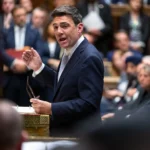
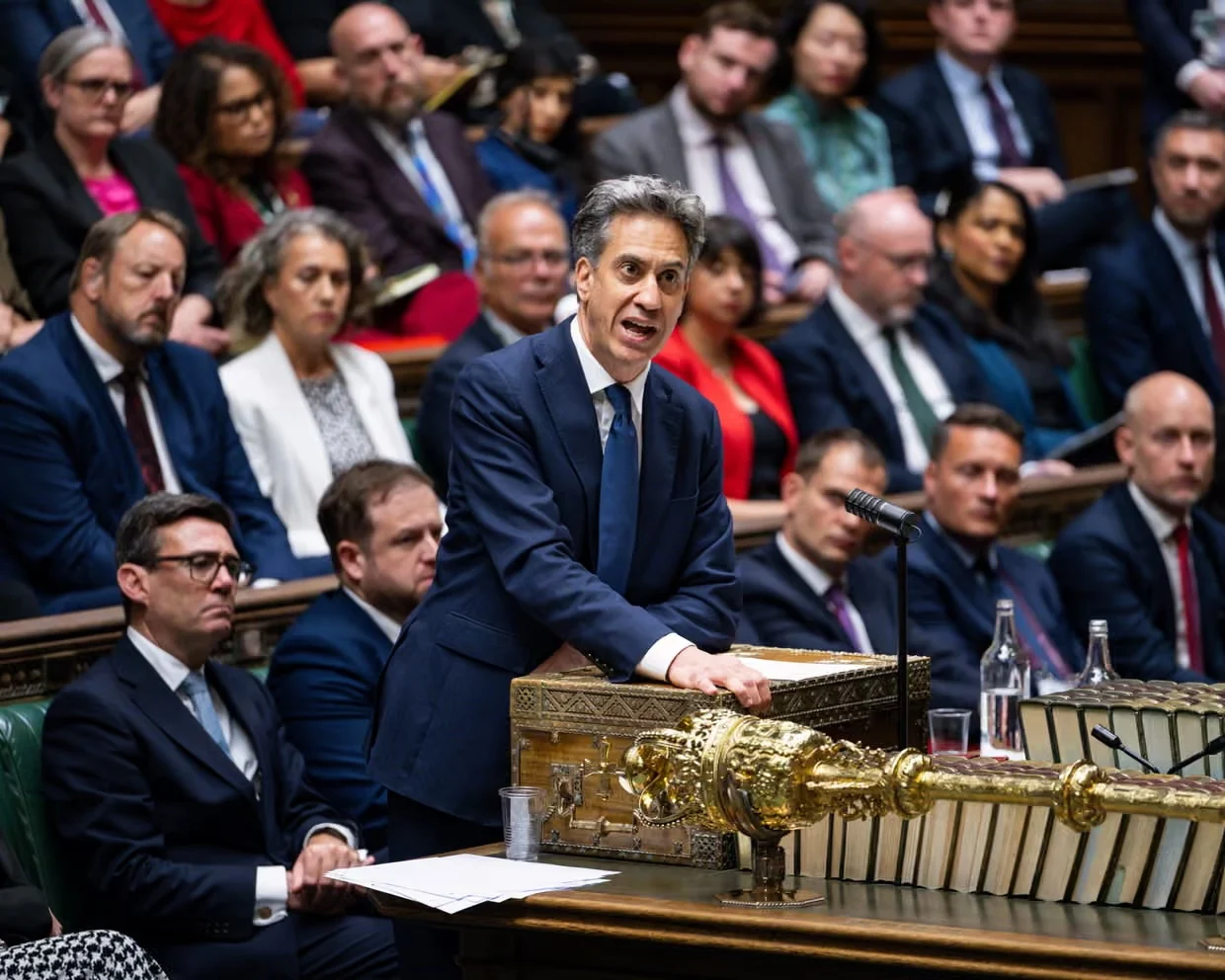
On 8 September 2026, Foreign Secretary Ed Miliband delivered the most significant British statement on Israel and Palestine in a generation. Standing at the despatch box as a self-described “proud British Jew,” Miliband announced a comprehensive package of measures: a ban on goods imported from Israeli settlements in the West Bank, sanctions on companies and individuals facilitating settlement expansion, and a refusal to grant licences for arms and exports that materially support what Britain now formally characterises as an “unlawful occupation.” In a moment of considerable political and personal courage, Britain’s most senior Jewish politician looked the Chief Rabbi in the eye, disagreed with him directly, and held the line for British values and international law. France and Canada announced parallel import bans on the same day, and Britain led a coalition of twelve nations, Canada, Denmark, Finland, France, Iceland, Ireland, Norway, Poland, Portugal, Spain, and Sweden, in a joint statement pledging to introduce national and European restrictions on trade with illegal settlements. The statement marked not an incremental adjustment to policy but a structural break: Britain has moved from the managed ambiguity of the Starmer years into a confident, values-driven foreign policy posture that reflects both the weight of international law and the depth of public feeling.
Israel’s response was swift and disproportionate. Within hours of Miliband’s statement, Foreign Minister Gideon Sa’ar announced a series of retaliatory measures agreed with Prime Minister Benjamin Netanyahu: the closure of the British Consulate General in East Jerusalem, the expulsion of British representatives from the US-backed International Gaza Support Centre, the termination of the British Support Team in Ramallah tasked with training Palestinian Authority Security Forces, and entry bans on twelve British elected officials and citizens, including former Labour leader Jeremy Corbyn and MP Zarah Sultana. Sa’ar described Miliband’s sanctions as “hostile,” “outrageous,” and driven by “domestic political reasons ahead of the Labour Party conference.” President Isaac Herzog called them a “grave miscalculation.”
The response reveals more about the Netanyahu government’s relationship with international law than it does about Britain’s. It deserves careful analytical scrutiny.
What Miliband Actually Said
The substantive content of the 8 September statement is worth setting out precisely, because it has been mischaracterised in some coverage as a symbolic gesture. It is not. Miliband told Parliament that at the time of the Oslo Accords in 1993, approximately 270,000 settlers lived in the occupied Palestinian territories. Today that figure is approximately 770,000. More settlements have been approved under the four years of the current Israeli government than in the previous twenty years. He cited United Nations reports of an average of six violent settler attacks against Palestinians per day in 2026, the highest on record, and stated that sixty-five Palestinian communities have been completely expelled since 2023, a total of over 4,000 people displaced from their homes entirely. He characterised this as “ethnic cleansing” and stated that the British government agrees that it is taking place, perpetrated by “settler terrorists” while the Israeli government has “turned a blind eye.”
Critically, Miliband stated that the British government now regards Israel’s control of the West Bank, not merely the settlements within it, as an unlawful occupation. This is a legal and political position of considerable significance. It is consistent with the International Court of Justice’s July 2024 advisory opinion, which concluded that Israel’s continued presence in the Occupied Palestinian Territory is unlawful and that it is under an obligation to end it as rapidly as possible. It is consistent with UN Security Council Resolution 242. It is consistent with a position the UK government has held since 1967, but which has not previously been stated with this degree of directness and backed with immediate regulatory action. France and Canada joining the import ban on the same day demonstrates that Britain is operating not unilaterally but as part of a coordinated Western realignment.
The Consulate Question: Israel Has No Legal Grounds
The closure of the British Consulate General in East Jerusalem is the most legally consequential of Israel’s retaliatory measures, and the one that most directly exposes the Netanyahu government’s contempt for the international legal framework it simultaneously invokes as protection.
The British Consulate General in East Jerusalem is located at 15 Nashashibi Street in the Sheikh Jarrah neighbourhood of East Jerusalem. It operates, and has operated since 1950, as the United Kingdom’s diplomatic representation to Jerusalem, the West Bank, and Gaza. The UK government’s own position on Jerusalem’s status, published on the FCDO website and unchanged since April 1950, is unambiguous: “The position of the UK government has remained constant since April 1950, when the UK extended de jure recognition to the State of Israel, but withheld recognition of sovereignty over Jerusalem pending a final determination of its status. We recognise Israel’s de facto authority over West Jerusalem. In line with Security Council Resolution 242 (1967) and subsequent Council resolutions, we regard East Jerusalem as under Israeli occupation.”
The consulate is therefore not an Israeli institution. It is not located in Israeli-recognised territory. It is located in occupied Palestinian territory, operating under the jurisdiction and for the purposes of UK-Palestine diplomatic relations. Israel does not possess internationally recognised sovereignty over East Jerusalem. UN Security Council Resolution 478, adopted in 1980 with fourteen votes to zero and one abstention from the United States, determined that all Israeli legislative and administrative measures purporting to alter the character and status of Jerusalem “are null and void and must be rescinded,” and called upon states that had established diplomatic missions in Jerusalem to withdraw them from the city. The ICJ reaffirmed in its 2024 advisory opinion that East Jerusalem is part of the Occupied Palestinian Territory and that Israel is not entitled to exercise sovereign authority there.
An analysis published by Diplomacy and Law on 9 September 2026 set out the precise legal difficulty Israel faces: “Israel’s effective control over East Jerusalem gives it the practical capacity to enforce the closure of the British Consulate General. That fact does not establish that Israel possesses the same legal competence that an undisputed territorial sovereign would ordinarily exercise over a foreign consular post. The ICJ has repeatedly distinguished occupation from sovereignty and held that Israel cannot derive sovereign powers over the Occupied Palestinian Territory merely from its status as occupying power.” Applying Article 4 of the Vienna Convention on Consular Relations, which places consent of the receiving state at the centre of consular arrangements, requires first accepting that Israel is the legitimate receiving state in East Jerusalem. Under international law, it is not.
Put plainly: by ordering the closure of the British Consulate in East Jerusalem, Israel is asserting sovereign authority over territory that the entire international community, including the United Kingdom, regards as occupied Palestinian land. It is, in the same gesture, demonstrating precisely why the British government’s characterisation of Israel’s occupation as unlawful is not merely politically convenient but legally accurate. Israel cannot simultaneously deny that it occupies East Jerusalem and claim the sovereign prerogative to expel a foreign diplomatic mission from it.
The Chief Rabbi, British Jews, and the Limits of Communal Veto
The most politically charged domestic response to Miliband’s statement came from Chief Rabbi Sir Ephraim Mirvis, who described 8 September as “truly a dark day for British Jews,” accused the government of ignoring “the deep concerns expressed by so many of us,” and warned that the measures “will succeed only in bolstering the very extremism they seek to target.” The Board of Deputies and the Jewish Leadership Council issued statements of “deep regret.” Gideon Sa’ar, predictably, amplified these voices as evidence that the sanctions endangered the British Jewish community.
Miliband’s response was both direct and analytically correct. Speaking to BBC Radio 4’s Today programme on 9 September, he said simply: “I don’t agree with the Chief Rabbi.” He told Jewish News that any person who targets British Jews because of the actions of the Israeli government “is an antisemite,” and stated clearly: “There are British Jews going about their lives, there are the actions of the Israeli government, and then there is our relationship with Israel.” These are three distinct things, he argued, and conflating them serves no one.
This distinction matters enormously, and it is one the Chief Rabbi’s statement conspicuously fails to make. The claim that sanctioning an occupying power’s illegal settlement enterprise endangers British Jews is not merely analytically weak — it instrumentalises the safety of British Jewish communities as a mechanism to shield the Netanyahu government from accountability. It treats the British Jewish community as a monolith whose interests are identical to the political positions of the Israeli government. They are not. Yachad UK, a British Jewish organisation that supports a political resolution to the Israeli-Palestinian conflict, welcomed the government’s action. Miliband himself, as a proud British Jew with deep personal and familial roots in the Jewish tradition, embodies the proposition that one can hold the safety and dignity of British Jews as an inviolable commitment whilst simultaneously concluding that the Netanyahu government’s conduct in the West Bank and Gaza is illegal and must be confronted. That is not a contradiction. It is the morally serious position.
Prime Minister Andy Burnham’s response to the Chief Rabbi was equally clear. “These sanctions are the right thing to do,” he said. “They are aimed not at the Israeli people, but at bringing peace in the region. The Israeli people are not responsible for the actions of their government.” Britain’s most senior Jewish cabinet minister and its Prime Minister speaking with one voice, in the face of communal pressure from the Chief Rabbi, the Board of Deputies, and the Israeli Foreign Ministry, is precisely what a more confident Britain looks like.
A More Confident Britain
The analytical significance of 8 September extends beyond the specific measures announced. It represents the clearest articulation yet of what Prime Minister Andy Burnham’s government means by a more confident British foreign policy.
The contrast with the Starmer years is structural, not merely tonal. Starmer’s government spent much of its tenure managing the tension between its stated commitment to international law and its reluctance to translate that commitment into action that might damage the transatlantic relationship or generate domestic political friction. The result was the architecture of managed ambiguity: arms licences partially suspended, genocide recognition carefully withheld, the 80-MP letter rejected. Critics, including this publication, documented the gap between rhetoric and action across the first months of that government’s tenure on Gaza.
Burnham’s government has not resolved every dimension of that tension. The F-35 exemption remains in the arms licensing regime. Genocide has not been formally recognised by the government. But 8 September marks a qualitative shift. A Foreign Secretary who opens a parliamentary statement by affirming his Jewish identity and his family’s debt to Israel, and then proceeds to accuse the Israeli government of facilitating ethnic cleansing and declare its occupation unlawful, is not performing diplomatic management. He is exercising political courage in the precise sense that term should carry.
The decision to act in concert with France and Canada rather than alone is equally significant. It signals that Britain’s foreign policy realignment on Palestine is not a domestic political gesture but a coordinated international position. The broader coalition of states signalling support for the import ban suggests a wider Western recalibration is underway, in which Britain is choosing to lead rather than follow.
That choice carries risk. Marco Rubio has already said the United States will “obviously” not be joining the sanctions. Israel’s entry bans on British MPs are a direct attempt to impose political costs on the government’s support base. The Netanyahu government’s characterisation of the measures as “hostile” and politically motivated is designed to delegitimise the policy by questioning its motives rather than its legal foundation. None of these pressures have so far moved the government from its position.
What Comes Next
Three things warrant close attention in the coming weeks. First, whether the settlement goods import ban is given formal legal effect through gazetted regulations on the timetable Miliband indicated, or whether it suffers the fate of many of its predecessors and remains a statement of intent. Second, whether the broader arms licensing regime is materially tightened beyond the settlement-related measures, and specifically whether the F-35 exemption is revisited. Third, whether Britain’s diplomatic response to the consulate closure is pursued through international legal channels, specifically through the Vienna Convention framework and potentially before the ICJ, rather than accepted as a fait accompli. A British government that has just declared Israel’s occupation of East Jerusalem unlawful is in a strong position to contest Israel’s legal authority to close a British diplomatic mission located in that occupied territory.
The Netanyahu government’s response to 8 September has been characterised by escalation, personal attacks on British officials, and the assertion of sovereign authority over territory it does not legally possess. It is the behaviour of a government that has grown accustomed to Western diplomatic deference and is discovering, belatedly, that deference has limits. Britain has found those limits. The question now is whether it holds the line.