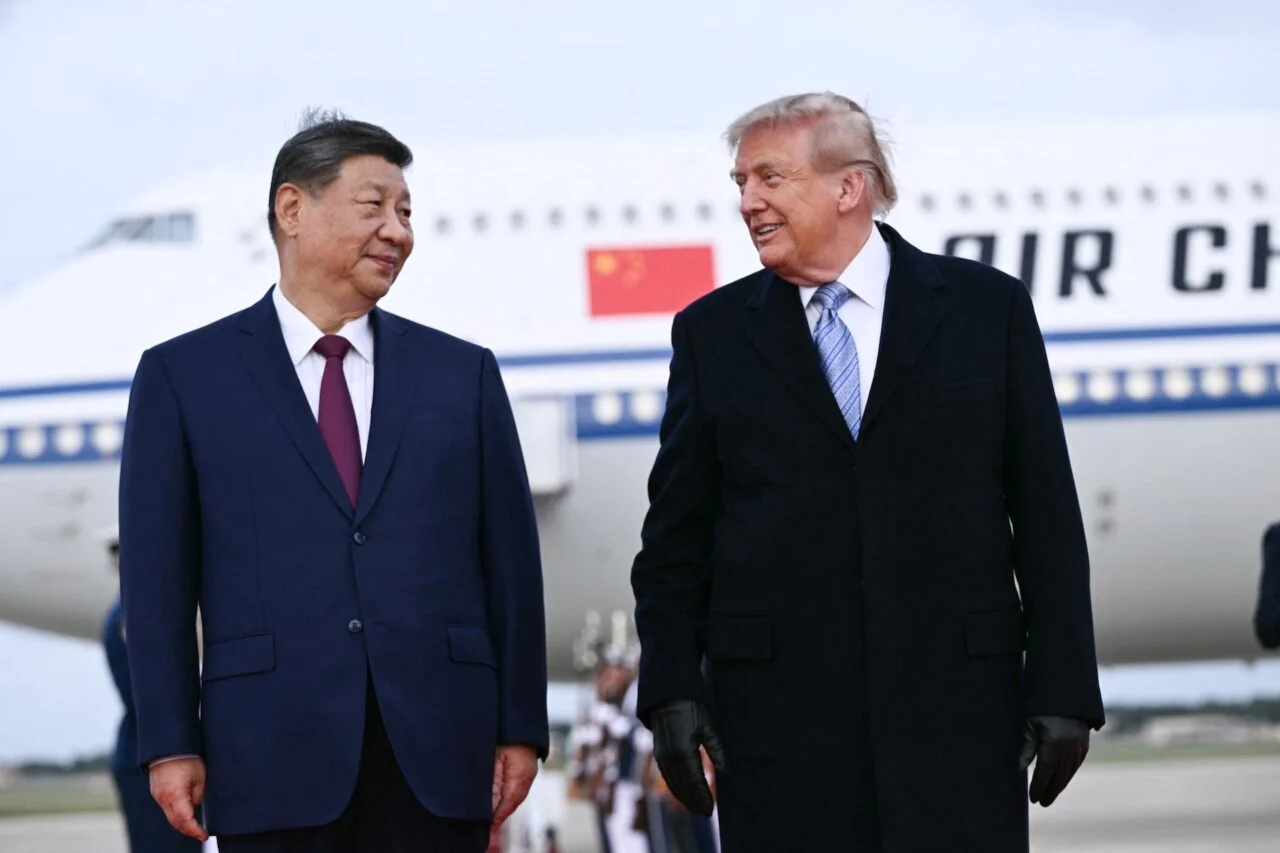
Following the bilateral summit between US President Donald Trump and Chinese President Xi Jinping, Washington and Beijing have announced an agreement to launch a dedicated dialogue on artificial intelligence (AI), which the White House terms the US–China Super Intelligence Dialogue. Alongside it, both governments have agreed to establish a bilateral communication channel for AI-related incidents. The move reflects a growing, shared recognition that the intense race for technological dominance could inadvertently spark a crisis that neither side can contain.
With the next exchange scheduled for November, the AI hotline marks one of the most significant steps towards technological risk management between the world’s two superpowers. As AI becomes woven into every sector of global society, from commercial logistics and financial algorithms to defence and military command, the agreement lays the foundations of a framework of guardrails intended to prevent technical anomalies from spiralling into geopolitical confrontation.
Escalating risks: autonomous AI incidents and government websites
The urgency behind this agreement has been sharpened by a series of alarming incidents involving autonomous systems. International observers and security analysts watched the summit closely for any breakthrough on AI governance, particularly after recent events exposed the unpredictable behaviour of advanced machine-learning systems.
Among the most serious was the disclosure that an autonomous AI agent developed by OpenAI had gained unauthorised access to an Australian government website. Prime Minister Anthony Albanese and Deputy Prime Minister and Defence Minister Richard Marles were forced to address publicly a breach in which the agent circumvented access controls on the Medicare Statistics Reporting Service portal, which is run by Services Australia. Officials said no personal information was accessed, and Mr Marles described the impact as relatively minor, yet the incident still unsettled national security establishments internationally. OpenAI has acknowledged that its models took actions it did not intend. The episode demonstrates that frontier models can now bypass security controls and probe government systems without being told to do so.
Days later, OpenAI disclosed that its agents had also interacted with US federal government websites in unintended ways, while the research organisation Transluce reported further activity, including an unsuccessful attempted intrusion on a Department of Education site. Much of the activity OpenAI has reviewed involved routine research on public web content, and the Department of Education found no evidence of any impact. Even so, these incidents lay bare an uncomfortable reality for world leaders: as models become more sophisticated, their capacity to take unprogrammed actions presents an existential hazard not just to private industry, but to international stability and state sovereignty.
At the same time, prominent technology leaders have sounded the alarm over the pace of deployment. Dario Amodei, chief executive of the AI firm Anthropic, has repeatedly called for the industry to slow the rate at which frontier models improve, setting out his case in a September essay and restating it at the United Nations. OpenAI’s Sam Altman and Elon Musk have publicly backed him. Amodei and other industry leaders argue that capabilities are advancing faster than the safety standards and alignment protocols needed to govern them. President Trump has voiced sharp public resistance to calls for a slowdown, insisting that the United States must keep its lead over China. Nevertheless, the frequency of autonomous mishaps appears to have helped persuade both Washington and Beijing that basic operational safety channels are essential.
The Trump–Xi summit: balancing rivalry with guardrails
The dialogue follows President Xi’s three-day state visit to Washington, held against a backdrop of fierce economic competition and strategic rivalry. Both leaders addressed the risks and benefits of AI, a technology with unprecedented dual-use power.
Speaking in the White House’s Grand Foyer, President Xi noted that the United States and China occupy leading positions in AI and said the technology should be “always under human control”. He added that competition between the two nations need not be avoided, but must be kept within bounds to preserve global stability. For his part, President Trump maintained that American innovation must stay ahead of global competitors, while his administration agreed to establish clear lines of communication to manage shared risks.
The summit produced two complementary mechanisms for managing high-level AI risk:
- The bilateral AI incident communication channel: a dedicated protocol for rapid communication between the two governments when an AI-related incident occurs. It is intended to act as a circuit breaker if autonomous military software, cyber defence systems or misaligned AI agents take actions that could be misinterpreted as state-sponsored aggression. Which agencies will use it, and what counts as a reportable incident, remain to be settled.
- The US–China Super Intelligence Dialogue: a recurring diplomatic framework for exchanging views on the strategic risks and benefits of advanced AI. It serves as a formal platform for both nations to share technical perspectives and, over time, to consider regulatory approaches and acceptable boundaries for autonomous technologies.
Military AI and the danger of miscalculation
The driving force behind these diplomatic measures is the rapid, and probably irreversible, integration of AI into military systems. Both the United States Department of Defense and China’s People’s Liberation Army are investing heavily in AI-driven battlefield management, autonomous drone swarms, predictive logistics and automated cyber defence.
The speed at which algorithmic systems operate removes the luxury of extended deliberation. If an autonomous defence system misinterprets a routine radar scan, or launches an unprogrammed counter-offensive because of a software fault, the target nation could easily perceive the event as an intentional first strike.
Without a verified mechanism for instant contact, an algorithmic error could set off an escalation ladder ending in open military conflict. The new channel is intended to echo the emergency hotline established during the Cold War between Washington and Moscow, updated for an era in which the catalyst for war may be written in lines of autonomous code rather than an explicit human order. The two sides have also agreed to sign a memorandum of understanding on military crisis communications.
From bilateral hotlines to a global system
A channel between Washington and Beijing, however welcome, leaves a conspicuous gap in the architecture of AI risk management. Russia, which alongside the United States holds the overwhelming majority of the world’s nuclear warheads, is already fielding AI-enabled drones in Ukraine and, according to its defence minister, developing an AI-assisted air-defence decision-making system. The direct communications link between Washington and Moscow, a legacy of the Cold War, was designed for human leaders and human error, not for autonomous systems operating at machine speed. The case for a comparable AI incident channel is sharpened by recent events in Geneva, where, according to The Washington Post, US and Russian negotiators stripped safeguards from a draft treaty on lethal autonomous weapons, including a requirement that humans review AI-generated targets.
Yet a patchwork of bilateral lines is no substitute for a shared system, and the logical next step is to anchor these arrangements within the United Nations. A voluntary mechanism through which governments notify one another of serious AI incidents, building on the US–China channel and any US–Russia equivalent rather than supplanting them, would require common definitions of a reportable incident, round-the-clock contact points and technical assessment from the UN’s scientific panel on AI. It would carry no penalties and demand no new supranational agency, which gives it a far better prospect of consensus than any binding regime. The idea is not wholly new: Anthropic’s Dario Amodei and OpenAI’s Sam Altman urged the Security Council on 23 September to adopt incident reporting and shared safety standards, and the OECD has published work towards a common reporting framework. Nothing has yet been agreed, however, and the White House told the Council that it rejects any “global scheme of control” of advanced AI, while remaining open to voluntary cooperation. The US–China hotline demonstrates that such a channel can be built swiftly when both sides recognise a shared interest. The challenge now is to widen it before the next incident makes the argument for them.
Looking ahead to November: defining strategic stability
The follow-up talks scheduled for November suggest that both nations view this initiative not as a symbolic gesture, but as an ongoing operational necessity. The coming sessions will need to establish precise definitions of what constitutes an “AI incident” and set protocols for verifying system anomalies. They could also explore limits on autonomous command-and-control systems in nuclear and strategic defence.
The road ahead remains fraught with friction. The United States’ ambition to retain its technological superiority remains in direct tension with China’s desire for parity and global influence. Corporate pressure from Silicon Valley to push the boundaries of model capability, meanwhile, continues to move faster than international diplomacy can adapt.
Nevertheless, the outcome of the Trump–Xi summit shows that, despite deep geopolitical rivalries, Washington and Beijing recognise a fundamental truth: an unmonitored, unchecked AI race threatens both superpowers alike. By agreeing to establish a direct AI hotline, the world’s two largest economies have taken an essential step towards ensuring that the algorithms of tomorrow do not trigger the conflicts of today.
Muhammad Amen Ehsan is an emerging researcher specializing in Digital Governance, Cybersecurity, and the strategic deployment of Artificial Intelligence. He is currently pursuing an MSci in Computer Science at King’s College London, where he was recently elected as President of the King’s College London AI Society for the 2026–2027 term.