The eighteenth BRICS summit closed in New Delhi with a joint declaration in hand, a result that India’s government has presented as a diplomatic triumph. Given that two earlier ministerial meetings this year had failed to produce any agreed text at all, the achievement is not trivial. Yet a closer reading of the New Delhi Declaration, and of the process that produced it, suggests that the bloc’s underlying divisions have not been resolved so much as managed out of the text. Consensus was reached, but largely by avoiding the issues on which members disagree most sharply.
A Declaration Built on Ambiguity
The headline diplomatic challenge in New Delhi was reconciling the positions of Iran and the United Arab Emirates on regional tensions in the Middle East, alongside the broader question of how, or whether, to address ongoing conflicts involving the United States and its allies. The compromise text reportedly expresses concern over escalation and calls for restraint, without naming any state responsible. This formula allowed Tehran, Abu Dhabi, Moscow and Beijing to sign the same document, but it does so by stripping the language of any real analytical or political content. A declaration that condemns unilateral warfare in the abstract, while declining to identify a single unilateral actor, is not a statement of shared purpose. It is a form of words designed to prevent the summit from collapsing.
This pattern is not new to BRICS, but it has become more pronounced as the bloc has expanded. With eleven members now spanning radically different alliances, energy interests and views on Western institutions, the search for language that offends no one increasingly produces declarations that commit no one to anything. The New Delhi Declaration reportedly runs to considerable length and touches on global governance reform, trade, payments cooperation and multilateral institutions, yet the substantive commitments within it are thin relative to its ambition. Breadth of subject matter has been substituted for depth of agreement.
The Limits of India’s Chairship
India entered its 2026 BRICS chairship with a stated ambition to convert the grouping’s collective weight into practical outcomes, a theme reflected in the summit’s own motto of resilience, innovation, cooperation and sustainability. New Delhi deserves credit for the logistical scale of the event and for the late-night diplomacy that ultimately produced a text acceptable to all eleven members. Indian officials have been quick to frame this as evidence of the country’s diplomatic capability, and there is something to that claim.
However, there is a tension in India’s dual role as both chair and interested party that deserves more scrutiny than it has received. India has used its presidency to advance its own institutional priorities, including its candidacy to host a future UN climate conference and the positioning of its domestic payments infrastructure as a model for the bloc. These are legitimate national interests, but a chair is also expected to act as an honest broker between members whose interests conflict. When the chairing state has its own agenda items competing for space in the final text, the process of consensus building becomes harder to separate from the process of consensus management in the chair’s own favour. The suspicion, whether or not it is fully justified, is that New Delhi’s priority was securing a signed declaration under its own name rather than resolving the substantive disputes that made agreement difficult in the first place.
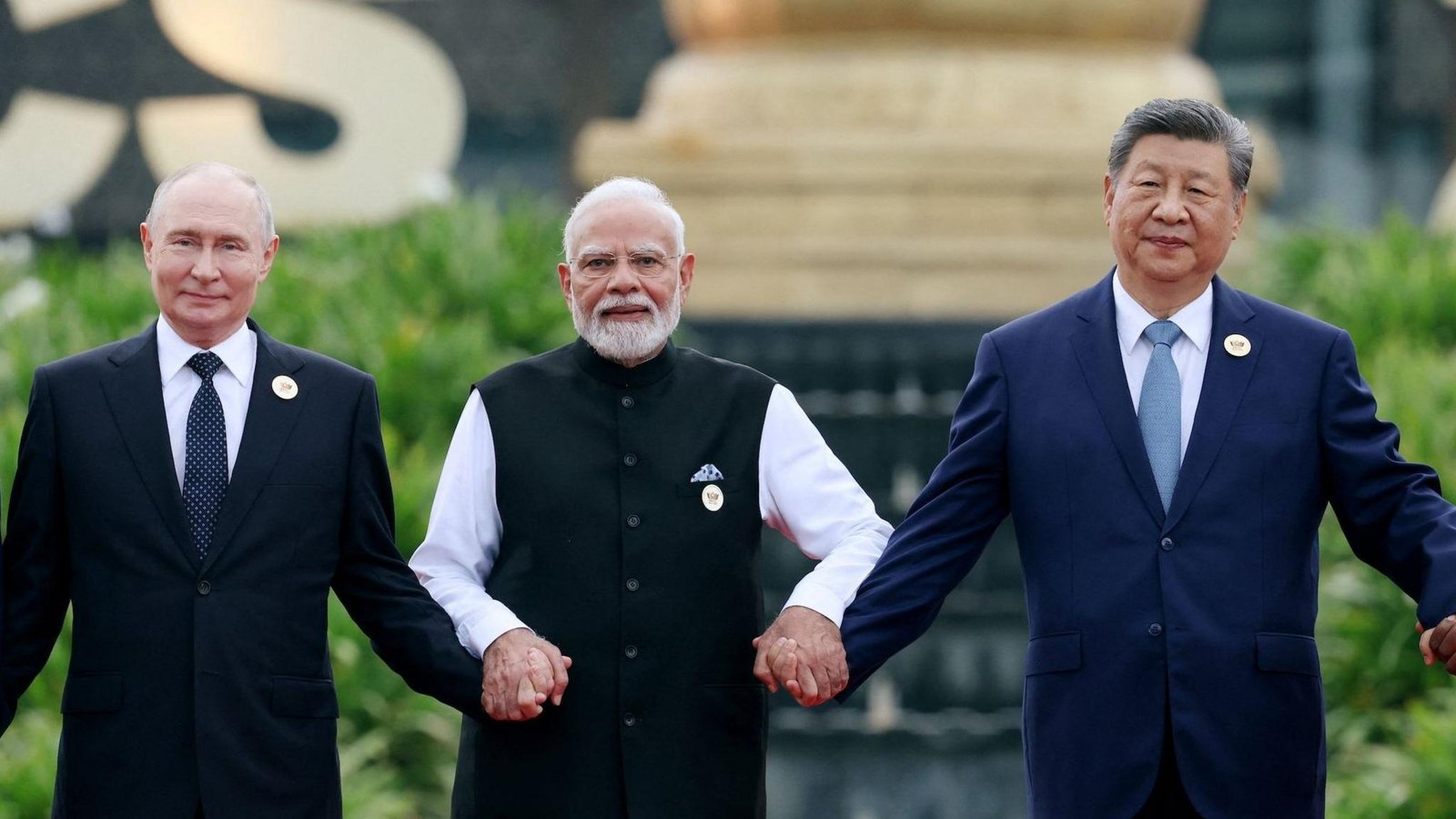
There is also a question of what hosting BRICS in New Delhi was meant to demonstrate. India has spent recent years positioning itself as a bridge between the Global South and Western institutions, a country that can sit comfortably in BRICS, the G20 and the Quad simultaneously. A summit that produces a declaration by carefully avoiding the issues that divide its own membership does little to support the claim that India can broker genuine consensus rather than simply paper over disagreement for the duration of a photograph.
National Agendas: How Key Members Navigated the Summit
The New Delhi summit functioned less as a forum for collective strategy than as a stage on which individual members pursued distinct national interests, each managing its own domestic and international audiences in the process.
India, as host, sought to present itself as a bridge between the Global South and the West, sustaining substantial trade ties with Western economies while deepening defence and economic cooperation within BRICS. Securing a clean joint declaration was, for New Delhi, as much a matter of domestic political credit as of diplomatic substance. Yet the government’s ambitions extended beyond the text itself. Indian pro-government media and diplomatic channels reportedly sought to press visiting partner leaders, most notably Malaysian Prime Minister Anwar Ibrahim, to explicitly endorse New Delhi’s framing of Pakistan as a state sponsor of terrorism following the Pahalgam attack in Jammu and Kashmir. Ibrahim declined to do so. While condemning terrorism in general terms and affirming his personal relationship with Prime Minister Modi, he stated that Malaysian security agencies had seen no intelligence linking the Pakistani state to the attack, and he drew a clear distinction between Israel’s actions in Gaza, which he described as state terrorism, and the cross-border dynamics with Pakistan. The episode illustrates the limits of a host state’s ability to convert summit diplomacy into endorsement of its own regional narrative, and sits uneasily alongside India’s stated ambition to act as a neutral convenor of the bloc.
China concentrated on consolidating the enlarged bloc into an economic architecture better insulated from Western sanctions and supply-chain reshoring. President Xi Jinping pressed for deeper integration in technology, critical minerals and digital financial systems, and Beijing ensured that the final text placed considerable emphasis on opposition to protectionism and to carbon border adjustment mechanisms, positions that align closely with China’s own trade interests and stand in direct tension with European and American policy.
Russia used the summit primarily for reasons of political normalisation, treating President Vladimir Putin’s presence at a major multilateral gathering as evidence that Moscow remains far from diplomatically isolated. In exchange for the omission of any direct reference to the war in Ukraine from the declaration, an omission that spared other members the discomfort of a public rupture, Russia secured support for institutional mechanisms intended to facilitate trade settlement and energy payments outside Western-dominated financial systems.
Iran and the United Arab Emirates illustrated the bloc’s difficulty in absorbing regional rivalries. Iran sought to use the platform to deepen its integration into non-Western institutions and to secure explicit condemnation of Western-backed military action in West Asia. The UAE, by contrast, prioritised trade pragmatism and worked to prevent the bloc from adopting an overtly anti-Western security posture that might complicate its own balancing act between East and West. Both states ultimately accepted a generalised, unattributed form of words on regional security rather than risk a public breakdown, a pattern consistent with the declaration’s broader reliance on ambiguity as the price of unity.
Read together, these national agendas suggest that the New Delhi Declaration was less a shared programme than a set of parallel accommodations, in which each member extracted the specific concessions or omissions it required and accepted vagueness everywhere else.
Strategic Outlook
The New Delhi summit was, on its own terms, a diplomatic success in the narrow sense that it avoided the embarrassment of a third consecutive failure to agree a text. That is a real accomplishment and should not be dismissed. But observers should be cautious about reading too much coherence into a declaration whose consensus rests so heavily on studied ambiguity. As chair, India secured the signatures. It did not resolve the disagreements that made those signatures so difficult to obtain, and its own interests in the outcome complicate any claim to have acted purely as a neutral broker. Whether BRICS can move beyond declarations of this kind, and towards agreements with genuine substance, will depend less on the skill of any single host and more on whether the bloc’s members are willing to confront the divisions they have so far preferred to write around.
[Image Credit: BBC]