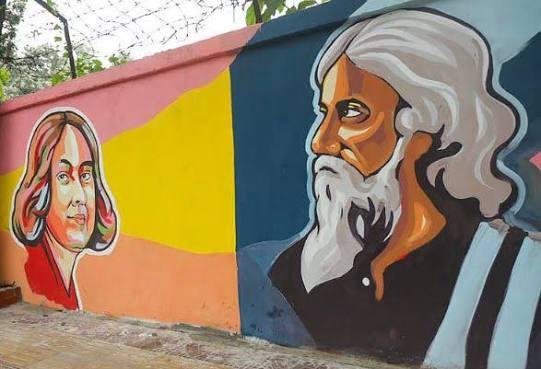
In October 2026, a newly installed mural of Nobel laureate Rabindranath Tagore was defaced with black ink in Bangladesh’s capital, Dhaka, prompting police to detain four people, including a woman. The incident occurred amid growing criticism over the choice of personalities featured on the wall, with objections raised over the inclusion of figures from West Bengal and the lack of female representation.
The vandalism took place outside the Bangladesh Shilpakala Academy in Segunbagicha, where portraits of prominent Bengali cultural figures had recently been installed as part of a footpath renovation project.
To the uncritical Western lens, the recent blackening of Rabindranath Tagore’s mural in Dhaka outside the Shilpakala Academy appeared to be a textbook instance of “cultural vandalism.” Foreign commentators and pro-Delhi commentators were quick to frame the act as yet another symptom of “rising religious fanaticism,” a crude, iconoclastic assault by “fundamentalists” against the “liberal humanism” of South Asia’s literary icon.
Yet this lazy narrative completely misreads the political landscape of post-revolution Bangladesh. The defacement of Tagore’s image was not an act of anti-intellectual nihilism; it was a visceral civil protest against the weaponization of a literary icon.
The Politics of Cultural Hegemony and Resistance
For decades, Rabindranath Tagore, the Bengali polymath who penned many impressive works, has been stripped of his literary nuance and converted into a political bludgeon. Under the tyrannical regime of Sheikh Hasina, whose fifteen-year rule was ended by the student-led July Revolution of 2024, a cynical alliance took shape. Pro-Indian Hindu nationalists from Bangladesh and Muslim-born fascists within the ruling Awami League deployed Tagorean Bengali culture as an instrument of hegemony. To be a “legitimate” and “secular” citizen in Hasina’s Bangladesh, one had to perform a specific brand of cultural orthodoxy dictated by New Delhi’s regional ambitions. Anyone who dissented was swiftly labeled an “Islamist threat” or an “anti-liberation traitor.”
Thus, when student activists covered Tagore’s face in black paint, they were not rejecting poetry or art; they were rejecting the coercive political apparatus that used his image to justify authoritarianism and external domination. It was an act of iconoclasm against an enforced hegemony that reduced complex national sovereignty into regional vassalage.
Mainstream Indian media and India’s Bangladeshi proxies have persistently painted this post-July resistance as mere “Muslim identity politics,” a retrograde surge toward a religious state. This framing is both disingenuous and dangerous. What is unfolding in Bangladesh is not a push for anything beyond democracy; it is a fundamental clash of value systems between Bengali Hindu politico-economic-cultural absolutism and a Muslim majority striving for a genuine civic people’s republic.
Reclaiming Democratic Aspirations from Foreign Narratives
The vast majority of Bangladeshi Muslims who took to the streets in July 2024, and who continue to defend the revolution’s gains, do not seek a state ruled by priests, as there is no priesthood in Islam. Their demand is for a civic people’s republic based on equal citizenship, judicial independence, freedom of speech, and strict constitutional safeguards against tyranny. They seek a sovereign nationhood where identity is rooted in democratic constitutionalism rather than forced cultural assimilation or feudal loyalty to a dynasty.
The claim that Bangladesh’s Muslim population desires a theocracy is a deliberate piece of propaganda engineered by pro-Indian networks. By stoking Western phobia of a “God-fearing regime” in Dhaka, these factions attempt to delegitimize the democratic aspirations of the Bangladeshi people and justify foreign intervention in the country’s sovereign affairs.
This propaganda becomes even more insidious when viewed alongside current developments across the border. In India, the ruling Hindu nationalist establishment actively persecutes Muslim citizens, disenfranchising them through discriminatory citizenship legislation, demolishing their homes and places of worship, and reducing them to lower-class status. These same Hindu nationalist networks maintain strong ideological and political links with radical Hindu factions in Bangladesh. While demanding total secular submission and minority privileges from Dhaka, they remain silent on, or actively support, the systemic oppression of Muslims in India.
This hypocrisy has alienated the generation of Bangladeshi youths who sparked the July Uprising. The Gen Z protesters who faced live ammunition on the streets of Bangladesh were fighting against fascism in all its forms, whether clad in the attire of secularism or pseudo-religiosity.
Forging an Autonomous Republic and Genuine Sovereignty
The battle currently raging across Bangladesh’s political landscape is not over whether the nation will be secular or religious. It is a battle for genuine sovereign nationhood. It is a struggle to define a country that belongs to all its citizens through democratic consensus rather than regional paternalism.
If Western observers wish to understand the symbols of Bangladesh’s new political dawn, they must look beyond the painted surfaces of murals. The blackening of Tagore’s portrait was a rejection of the political chains forged in his name. Bangladesh is asserting its right to write its own future, a civic, sovereign people’s republic free from ghosts of tyranny and foreign patronage.
This struggle represents an irrepressible drive toward decolonizing the state architecture, dismantled piece by piece after decades of institutional capture. By reclaiming public spaces and questioning long-unexamined paradigms of secularism, the movement exposes how elite cultural monopolies were manufactured to keep the populace docile and dependent on external powers.
Ultimately, this battle of ideologies will determine whether Bangladesh remains bound by an inherited, post-colonial framework of cultural compliance or emerges as a fully autonomous republic driven by its own civic consciousness. By reclaiming public space and challenging manufactured paradigms of secularism and nationalism, the post-revolution movement is demanding a recalibration of what it means to be sovereign. It is a declaration that true nationhood cannot be imported, engineered, or policed from external capitals, but must be continuously forged by the collective, democratic will of its own people.
Mohammad Basir-Ul-Haq Sinha is the chief executive officer of the Inter Press Network, a Dhaka-based news agency. He also acts as secretary general of the Citizens Power, a movement stitched together from Bangladesh’s July Revolution of 2024. His intellectual range falls into two distinct spheres: geopolitics and the dynamics of power; the labyrinth of history and cultural anthropology.