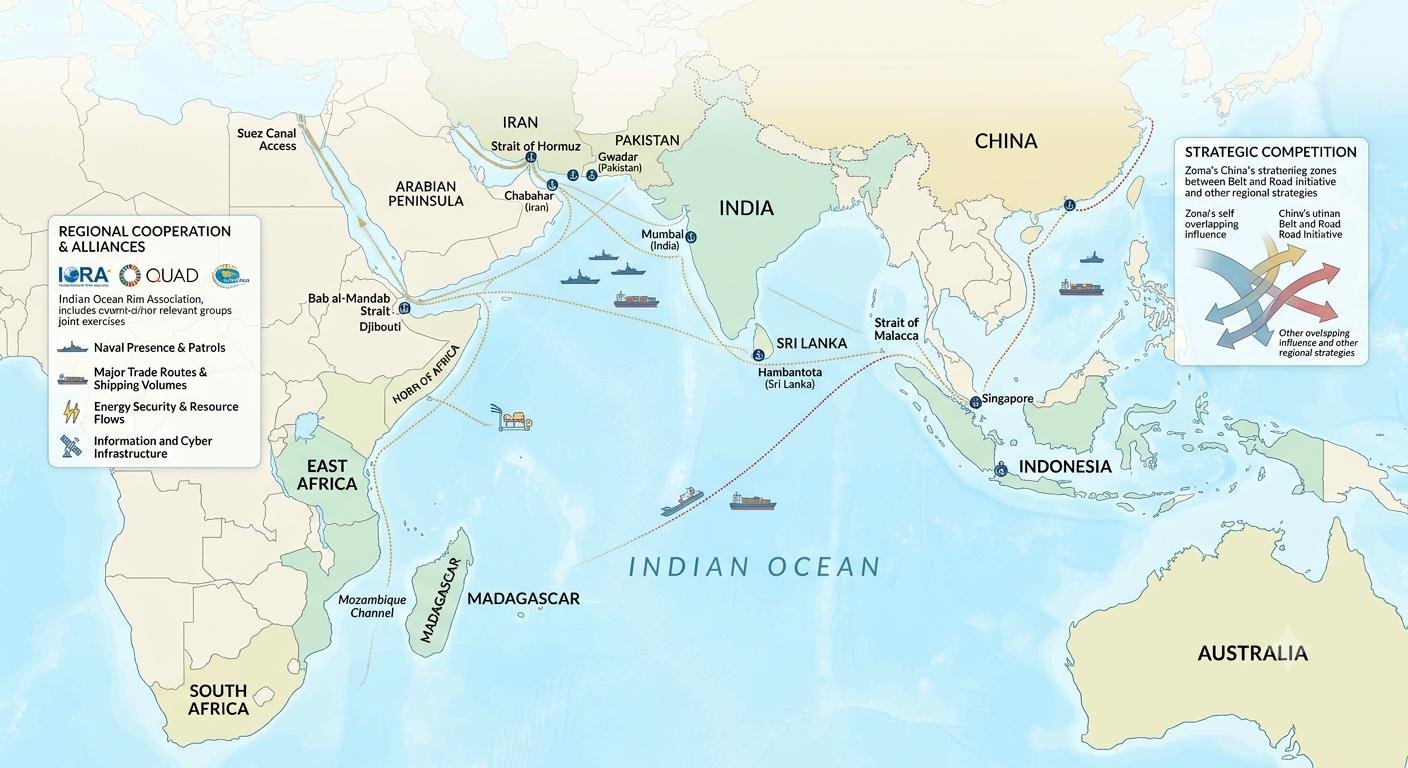
The Indian Ocean has emerged as one of the most consequential geopolitical theatres of the twenty-first century. Stretching from the eastern coast of Africa to the western Pacific through the Strait of Malacca, it connects some of the world’s fastest-growing economies while carrying nearly 80 per cent of global seaborne oil trade and a substantial share of international container shipping. Its maritime chokepoints, including the Strait of Hormuz, Bab el-Mandeb, and the Strait of Malacca, serve as strategic arteries linking the Middle East, Africa, Europe, and Asia. Consequently, any disruption in these waters has immediate repercussions for global energy markets, international trade, and regional security.
Unlike during the Cold War, when competition was largely bipolar, today’s Indian Ocean is characterised by a complex multipolar environment. Traditional maritime powers such as the United States, the United Kingdom, and France coexist with emerging strategic actors including China, Japan, Australia, and the Gulf states. At the same time, India increasingly views the Indian Ocean as its primary strategic sphere, while regional island nations seek to balance competing interests without compromising their sovereignty.
This evolving security landscape has generated a fundamental question: do extra-regional powers contribute to regional stability through enhanced security cooperation and economic investment, or do they inadvertently intensify geopolitical competition by transforming the Indian Ocean into another arena of great-power rivalry? While external involvement has strengthened maritime security in several respects, it has also heightened military competition, strategic mistrust, and political fragmentation. The resulting stability is therefore conditional, fragile, and increasingly shaped by geopolitical calculations rather than cooperative regional governance.
The Strategic Evolution of the Indian Ocean
Historically, the Indian Ocean served as a crossroads of commerce, connecting civilizations across East Africa, the Arabian Peninsula, South Asia, and Southeast Asia. For centuries, maritime trade networks facilitated not only economic exchange but also the spread of cultures, religions, and political influence. European colonial powers later recognized the region’s strategic value, establishing naval bases and commercial outposts that enabled control over critical sea routes.
During the Cold War, the Indian Ocean became an important theatre in the strategic competition between the United States and the Soviet Union. Although the rivalry remained less militarized than in Europe, naval deployments, intelligence facilities, and strategic bases reflected broader ideological competition. Following the Soviet Union’s collapse, the region experienced a temporary reduction in military rivalry, allowing issues such as piracy, humanitarian assistance, disaster relief, and economic integration to dominate regional agendas.
This relative calm began to dissipate with China’s economic rise, India’s growing regional ambitions, and the introduction of the United States’ Indo-Pacific strategy. Maritime competition gradually replaced counter-piracy as the defining feature of the regional security environment. Today, geopolitical rivalry increasingly shapes infrastructure investment, naval modernization, technological competition, and diplomatic engagement throughout the Indian Ocean.
China’s Expanding Maritime Footprint
China’s emergence as a major maritime power represents one of the most transformative developments in the contemporary Indian Ocean. Driven by its dependence on imported energy and overseas trade, Beijing has invested heavily in securing maritime supply chains through the Belt and Road Initiative (BRI), particularly its Maritime Silk Road component.
Chinese-funded infrastructure projects, including ports in Gwadar (Pakistan), Hambantota (Sri Lanka), Kyaukpyu (Myanmar), and facilities in East Africa, have significantly expanded Beijing’s economic presence. While officially presented as commercial investments designed to improve regional connectivity, many analysts argue that these projects possess strategic value because they can potentially support naval logistics, intelligence gathering, and military operations.
The establishment of China’s first overseas military base in Djibouti in 2017 fundamentally altered perceptions of Beijing’s intentions. Situated near the Bab el-Mandeb Strait, the facility enables China to support anti-piracy missions, protect commercial shipping, evacuate nationals during crises, and sustain long-distance naval deployments. However, its existence also symbolises China’s transition from a continental power into a blue-water naval actor capable of projecting military influence far beyond the South China Sea.
This growing presence has intensified concerns regarding the so-called “String of Pearls” strategy, a network of commercial ports and strategic access points extending across the Indian Ocean. Although Beijing rejects this characterization, regional powers increasingly interpret Chinese infrastructure investments through a security lens, contributing to heightened strategic suspicion.
India’s Maritime Response
For India, the Indian Ocean represents far more than a commercial waterway; it is central to its national identity, economic security, and regional influence. India’s geographic position provides significant strategic advantages, enabling it to monitor maritime traffic across much of the northern Indian Ocean. Consequently, New Delhi has consistently emphasised that regional security should primarily be managed by resident powers.
India’s maritime doctrine has evolved considerably over the past decade. Through initiatives such as Security and Growth for All in the Region (SAGAR), the Indo-Pacific Oceans Initiative (IPOI), and strengthened naval partnerships with neighbouring states, India seeks to promote an inclusive regional order while simultaneously counterbalancing China’s growing influence.
New Delhi has expanded defense cooperation with island states including Mauritius, Seychelles, the Maldives, and Sri Lanka through capacity-building, maritime domain awareness programs, coastal radar networks, and infrastructure assistance. Simultaneously, India has accelerated naval modernization by investing in aircraft carriers, nuclear-powered submarines, long-range surveillance aircraft, and indigenous shipbuilding capabilities.
India’s strategic approach reflects a delicate balancing act. While trying to strengthen security partnerships with countries such as the United States, Japan, Australia, and France, New Delhi also seeks to preserve its tradition of strategic autonomy by avoiding formal military alliances. This nuanced approach enables India to enhance deterrence without appearing to subordinate its regional leadership ambitions to external powers.
Pakistan’s geopolitical strategy
Pakistan’s geopolitical strategy is shaped by its strategic location at the crossroads of South Asia, Central Asia, the Middle East, and the Indian Ocean. The country seeks to strengthen its national security, expand regional connectivity, and enhance economic development through initiatives such as the China, Pakistan Economic Corridor (CPEC), which links western China to the Arabian Sea via Gwadar Port.
Pakistan’s position along the northern Arabian Sea gives it significant importance in the Indian Ocean, one of the world’s busiest maritime trade routes through which a large share of global energy supplies and commercial goods pass. Gwadar Port provides access to key sea lanes near the Strait of Hormuz, making Pakistan an important stakeholder in regional maritime security, trade, and energy transportation.
At the same time, Pakistan’s role in the Indian Ocean is influenced by its relationships with major powers, including China, the United States, Gulf countries, and neighboring India, making it a significant actor in the region’s evolving strategic and economic landscape.
The United States and the Indo-Pacific Strategy
The United States remains the most capable extra-regional military actor in the Indian Ocean. Its enduring presence is anchored by the strategically significant base at Diego Garcia, which provides logistical support for operations across the Middle East, East Africa, and the broader Indo-Pacific.
Washington’s Indo-Pacific Strategy reflects growing concern over China’s expanding military and economic influence. Rather than maintaining uncontested dominance, U.S. policy increasingly focuses on preserving a favorable balance of power through partnerships with regional democracies and like-minded states.
Security initiatives such as the Quadrilateral Security Dialogue (QUAD), enhanced naval exercises like Malabar, and expanded intelligence cooperation seek to improve maritime interoperability among partner nations. Beyond military objectives, the United States also emphasizes freedom of navigation, secure sea lines of communication, and adherence to international maritime law.
Nevertheless, many regional states remain cautious about becoming entangled in Sino-American competition. While they welcome security assistance and investment, they generally prefer an inclusive regional order that avoids forcing smaller countries into binary strategic choices.
Europe’s Renewed Strategic Interest
Although often overlooked, European powers continue to play an influential role in the Indian Ocean. France maintains sovereign territories including Réunion and Mayotte, providing Paris with one of the largest exclusive economic zones in the region. French naval deployments, intelligence assets, and defense partnerships underscore its long-term commitment to regional stability.
The United Kingdom has similarly sought to reinforce its maritime presence following Brexit, emphasizing defense cooperation with Indo-Pacific partners under its “Global Britain” strategy. Meanwhile, the European Union increasingly views the Indian Ocean through the interconnected lenses of maritime security, supply-chain resilience, and energy security.
Japan and Australia have also emerged as increasingly important stakeholders. Japan’s emphasis on a “Free and Open Indo-Pacific” aligns closely with efforts to strengthen infrastructure quality, maritime governance, and regional connectivity. Australia has expanded defense cooperation throughout the eastern Indian Ocean while increasing investments in maritime surveillance and humanitarian assistance capabilities.
Collectively, these actors contribute to a diversified regional security architecture that extends beyond traditional U.S.-China competition.
Small States and Strategic Balancing
Contrary to perceptions that they are merely passive recipients of external influence, smaller Indian Ocean states have demonstrated considerable diplomatic agency. Countries such as Sri Lanka, the Maldives, Mauritius, Seychelles, and Djibouti frequently pursue multidirectional foreign policies designed to maximize economic opportunities while preserving strategic autonomy.
Infrastructure financing, tourism, fisheries, climate adaptation, and maritime security have become central bargaining tools in negotiations with larger powers. Rather than aligning exclusively with one actor, many governments deliberately diversify partnerships to avoid excessive dependence.
However, this balancing strategy carries inherent risks. Domestic political polarization, debt sustainability concerns, and external pressure can complicate national decision-making, occasionally transforming infrastructure projects into symbols of geopolitical competition. The debate surrounding Sri Lanka’s Hambantota Port illustrates how commercial investments can rapidly acquire strategic significance when viewed through the prism of great-power rivalry.
Emerging Domains of Competition
Competition in the Indian Ocean increasingly extends beyond naval deployments. Control over digital infrastructure, submarine communication cables, satellite surveillance, artificial intelligence, cyber capabilities, and maritime data networks has become equally significant.
Undersea fiber-optic cables carry the overwhelming majority of global internet traffic and financial transactions, making their protection a strategic priority. Similarly, advances in unmanned systems, autonomous underwater vehicles, and space-based maritime surveillance are transforming naval operations by improving situational awareness and intelligence collection.
Climate change further complicates regional security. Rising sea levels threaten low-lying island nations, while increasingly severe cyclones and environmental degradation place additional pressure on fragile economies. As a result, humanitarian assistance, disaster response, and climate resilience have become integral components of maritime security policy.
The concept of the blue economy has also gained prominence. Sustainable fisheries, offshore renewable energy, seabed resources, and marine conservation increasingly intersect with national security considerations, demonstrating that economic and environmental governance can no longer be separated from geopolitical competition.
Regional Institutions and Their Limitations
Regional organisations have attempted to foster cooperative security despite intensifying rivalry. Institutions such as the Indian Ocean Rim Association (IORA), the Indian Ocean Naval Symposium (IONS), and various ASEAN-led mechanisms promote dialogue on maritime safety, disaster response, trade, and sustainable development.
However, these institutions remain constrained by consensus-based decision-making, limited enforcement mechanisms, and divergent strategic priorities among member states. Unlike NATO or other formal security alliances, the Indian Ocean lacks a comprehensive regional architecture capable of managing military competition or resolving strategic disputes.
Consequently, security cooperation often occurs through overlapping bilateral and minilateral arrangements rather than inclusive regional institutions. While these flexible partnerships enhance operational effectiveness, they can also deepen geopolitical fragmentation by creating competing security networks.
The Future of Regional Stability
The future of the Indian Ocean will depend less on the presence of extra-regional actors than on how they conduct their engagement. External investment, naval cooperation, and technological collaboration can strengthen regional resilience if pursued transparently and in accordance with international law. Conversely, infrastructure militarization, coercive diplomacy, and zero-sum strategic competition risk transforming the region into an enduring arena of geopolitical confrontation.
A stable Indian Ocean requires a balanced security architecture that recognises both the legitimate interests of resident powers and the global importance of maritime commons. Confidence-building measures, information sharing, coordinated humanitarian operations, and stronger regional institutions can reduce strategic mistrust while preserving freedom of navigation and open commerce.
Ultimately, smaller states must remain active participants rather than passive objects of great-power competition. Their diplomatic choices, regional initiatives, and institutional leadership will significantly influence whether the Indian Ocean evolves into a cooperative maritime order or a fragmented geopolitical battleground.
The Indian Ocean has become the epicentre of twenty-first-century geopolitical competition, where economic interdependence coexists uneasily with strategic rivalry. Extra-regional actors undoubtedly contribute valuable investments, maritime security capabilities, disaster relief, and technological expertise. Yet their expanding presence also reinforces military competition, strategic polarisation, and competing visions of regional order.
The notion that external involvement automatically guarantees stability is therefore increasingly untenable. Stability in the Indian Ocean cannot be measured solely by the absence of armed conflict; it must also encompass resilient institutions, sustainable development, sovereign decision-making, and cooperative maritime governance. As global power continues to shift towards the Indo-Pacific, the Indian Ocean will remain both a strategic crossroads and a testing ground for the evolving international order. Whether it becomes a domain of collaborative security or prolonged rivalry will depend not only on the ambitions of great powers but also on the collective capacity of regional states to shape the rules governing this increasingly contested maritime space.