Burnham’s government speaks about Gaza in a markedly different register from its predecessor’s. It has not, so far, acted in one. That gap is the finding here, not a puzzle to explain away. In late July, 80 MPs and peers wrote asking Burnham to recognise the UN Commission of Inquiry’s genocide finding and impose sanctions accordingly. The request was rejected. The arms licensing regime has continued largely unchanged. Against that, one part of government, the Foreign Office under Ed Miliband, is visibly building toward something more, with announcements trailed for this month. The government has not yet changed its Gaza policy. It has built more institutional capacity to do so than its predecessor had. Whether that capacity gets used is now a matter of weeks, not interpretation.
Six weeks, read structurally
Burnham took office on 20 July with 94 percent of parliamentary nominations, the highest share in Labour’s modern history, having returned to the Commons only weeks earlier via a by-election after a decade as Mayor of Greater Manchester. He arrives with a strong retail brand and no tested foreign policy record, and the interesting question is what that combination produces once routine parliamentary scrutiny begins.
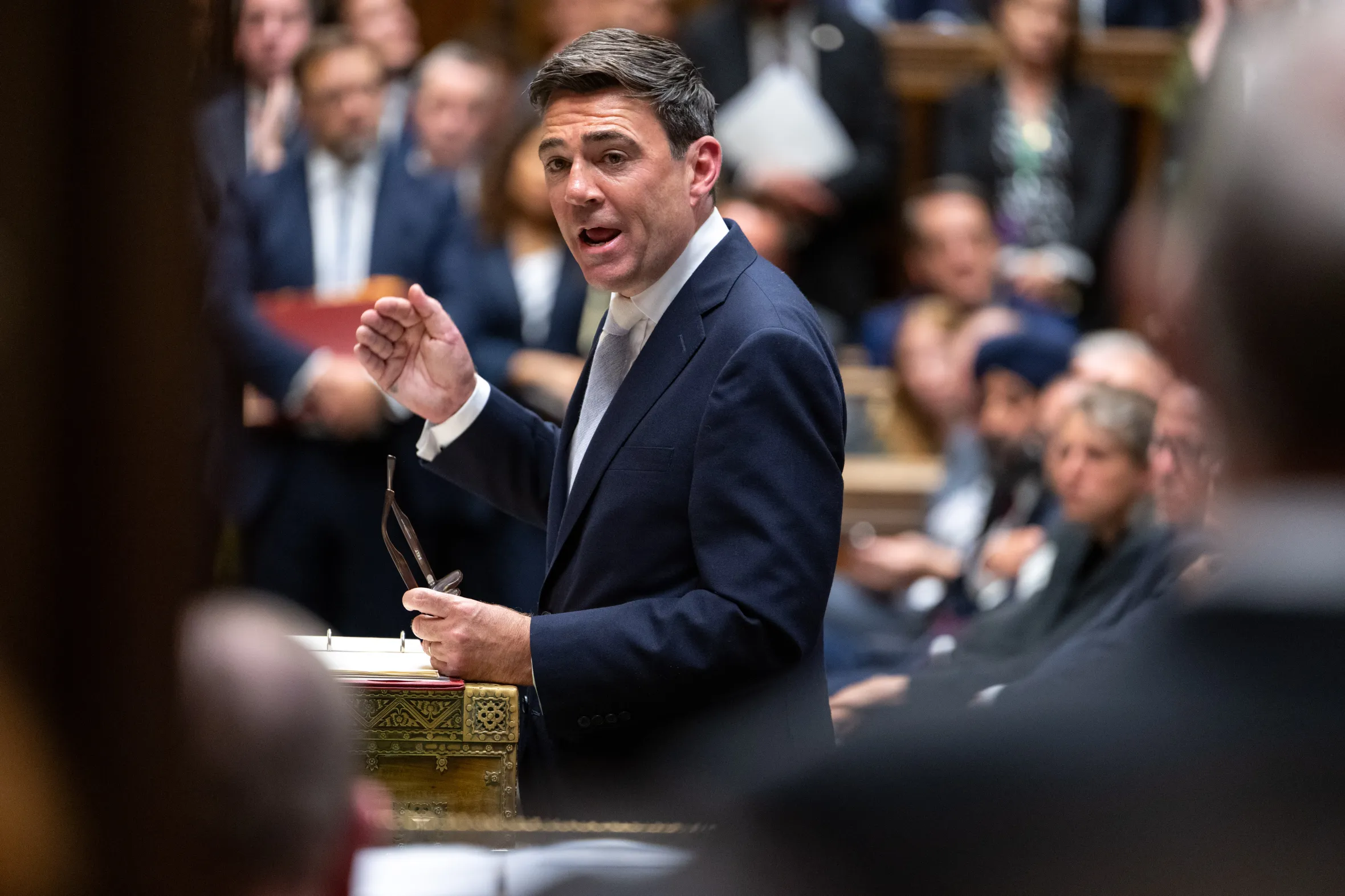
Two moments this week answer it. On Tuesday, Burnham made his first Commons statement in sixteen years, an almost entirely domestic performance built around public ownership of water, energy and transport. The same afternoon, Miliband separately answered departmental questions on the arms trade with Israel and West Bank settlements. That division, repeated across the summer, is the structural feature worth tracking: domestic renewal is where the Prime Minister puts his own voice; the hardest foreign policy question of the moment is handled elsewhere.
That split has been consistent since Burnham took office, not just this week. His own public statements, the Kyiv visit for the “coalition of the willing” aside, have stayed almost entirely domestic: bus fares, energy bills, business rates, water and public ownership. Gaza has been the one major foreign policy question of his premiership so far, and he has addressed it exactly once, in a pre-appointment video statement, rather than in the Commons or at any point since. Everything that has happened on the substance since, the rejected letter from 80 MPs, the ongoing licensing decisions, the settlement-goods policy now being worked up, has been conducted through Miliband and the Foreign Office rather than through the Prime Minister directly. Whether that is a deliberate division of labour or simply reflects where Burnham’s interests and experience lie, the effect is the same: on the question that has generated the most sustained political pressure on this government, the Prime Minister has said the least.
The apology and what came after it
On 9 July, before formally taking office, Burnham said Labour “didn’t get it right” on Gaza and that the “unbearable suffering” there was “a scar on our collective conscience.” He acknowledged “increasing evidence that war crimes appear to have been committed,” while explicitly leaving genocide as a determination for “international courts, and not politicians.” This addressed tone, not substance, and the refusal to name genocide was the more consequential omission: a UN Commission of Inquiry had already reached that conclusion, echoed by a substantial body of scholars and rights organisations, though it is worth being precise that no court has issued a final ruling and the ICJ case brought by South Africa remains at the provisional-measures stage, a characterisation Israel disputes.
Reception split predictably. Tim Bale of Queen Mary University called it an attempt to “repair damage” that was “probably more symbolic than substantive,” a comment on political effect rather than legal substance. Jeremy Corbyn made a sharper, more specific claim: that the government’s own stated justification for its arms policy, that UK exports could not plausibly be used against Gaza, was inconsistent with keeping any exports restricted at all. If ministers believed that, he argued, there was no reason to maintain even a partial suspension; if they did not believe it, the honest response was to end the trade, including F-35 components, rather than issue a hedged, partial policy and call it done. Pro-Israel voices, including the Board of Deputies of British Jews, took the opposite view, that the apology overcorrected. The government’s subsequent conduct, detailed below, has tracked far closer to Corbyn’s reading than to the complaint that it went too far.
The clearest evidence is not interpretive. In late July, 80 MPs and peers, organised by Labour MP Kim Johnson and including Corbyn and Diane Abbott among the signatories, wrote directly to Burnham asking his government to recognise the UN Commission of Inquiry’s genocide finding, implement the ICJ’s 2024 ruling, and impose sanctions including a full arms embargo. The government rejected the request. This is not a matter of tone or interpretation; it is a specific, dated decision, taken within days of the letter, that declined to convert stated regret into the most direct action available.
The arms data tell the same story, and this is where the F-35 point actually matters rather than being a side detail. The September 2024 suspension covered around 30 of roughly 350 UK arms export licences to Israel, but it explicitly excluded UK components entering the global F-35 programme, on the grounds that Britain’s roughly 15 per cent contribution to F-35 parts could not be isolated for a single destination without disrupting the wider multinational supply chain. F-35 components are, by most estimates, the largest and most militarily significant category of UK-Israel arms trade, which means the F-35 exemption is the specific mechanism by which a government can accurately say it “suspended” arms exports to Israel while the most consequential category of that trade continues unaffected. The licensing regime Burnham inherited from Starmer illustrates the scale of what has not yet changed: £20.5 million in new licences were issued in Q4 2025 alone under the previous administration, including an £8.7 million Open Individual Export Licence for targeting equipment, a category the September 2024 suspension was explicitly designed to prohibit, issued despite CAAT warning of diversion risk. Burnham’s government has not, as of the time of writing, revoked these licences or announced a measurable reduction in the licensing baseline. A separate joint investigation by the Palestinian Youth Movement, Progressive International, and Workers for a Free Palestine found 14 UK-to-Israel military shipments since October 2023, one of which alone, by sea to Haifa, contained over 160,000 items. Since 2015 the UK has licensed at least £500 million in military exports to Israel, a figure genuinely small next to Israel’s principal suppliers, which does not resolve the separate question of UK component criticality in the F-35 programme specifically.
The counter-evidence: Miliband
No fair account stops there. Miliband is reported to be pushing internally for stronger measures, including a settlement-goods ban, and has publicly condemned Israel’s E1 settlement tender while summoning its chargé d’affaires. He brings independent international standing Burnham lacks on foreign affairs, and his relationship with US Secretary of State Marco Rubio suggests the harder line is not, so far, costing the transatlantic relationship, historically the reason British governments have hedged here. Burnham himself is separately reported to want a firmer position than Starmer’s on settlements specifically, so this looks like a shift shared at the top of government, with Miliband its more visible executor, rather than one minister running ahead of a reluctant prime minister.
This does not close the gap described above; it changes what the gap means. A foreign secretary with independent standing, actively shaping policy, is a materially different starting point than a single video statement standing in for the whole government position, even before September’s promised measures land.
Looking Forward
Three things follow. This preference for the visible over the structural is not unique to Gaza; it runs through the whole government. The bus fare cap, the energy VAT cut, the business rates cut and the Gaza apology are all the same kind of move: quick, easy-to-explain announcements that come well before the slower work of actually delivering them. That fits Burnham’s background. As a city-region mayor, visible, fast wins were exactly what earned him credit, and he appears to be governing the same way now. Foreign policy authority looks genuinely distributed rather than simply delegated, and the practical effect is a foreign secretary operating with real latitude on the most contested question this government faces. Put simply: on Gaza, this government has changed its words but not, so far, its actions. The apology was real rhetorical change. But the two clearest tests of substance, whether to recognise the genocide finding and whether to actually cut arms exports, both came back the same way they would have under Starmer: the letter was rejected, and the licensing data shows continuity, not decline. So the fair summary is this: Burnham’s government now says the things about Gaza that its critics wanted Starmer’s government to say. It just hasn’t yet done anything that Starmer’s government wouldn’t also have done. The test that actually settles this is mechanical, not further tone: whether September’s settlement-goods ban arrives, and whether the next licensing release shows a measurable fall rather than continuity. The answer will be visible in gazetted regulations, not in another video statement.