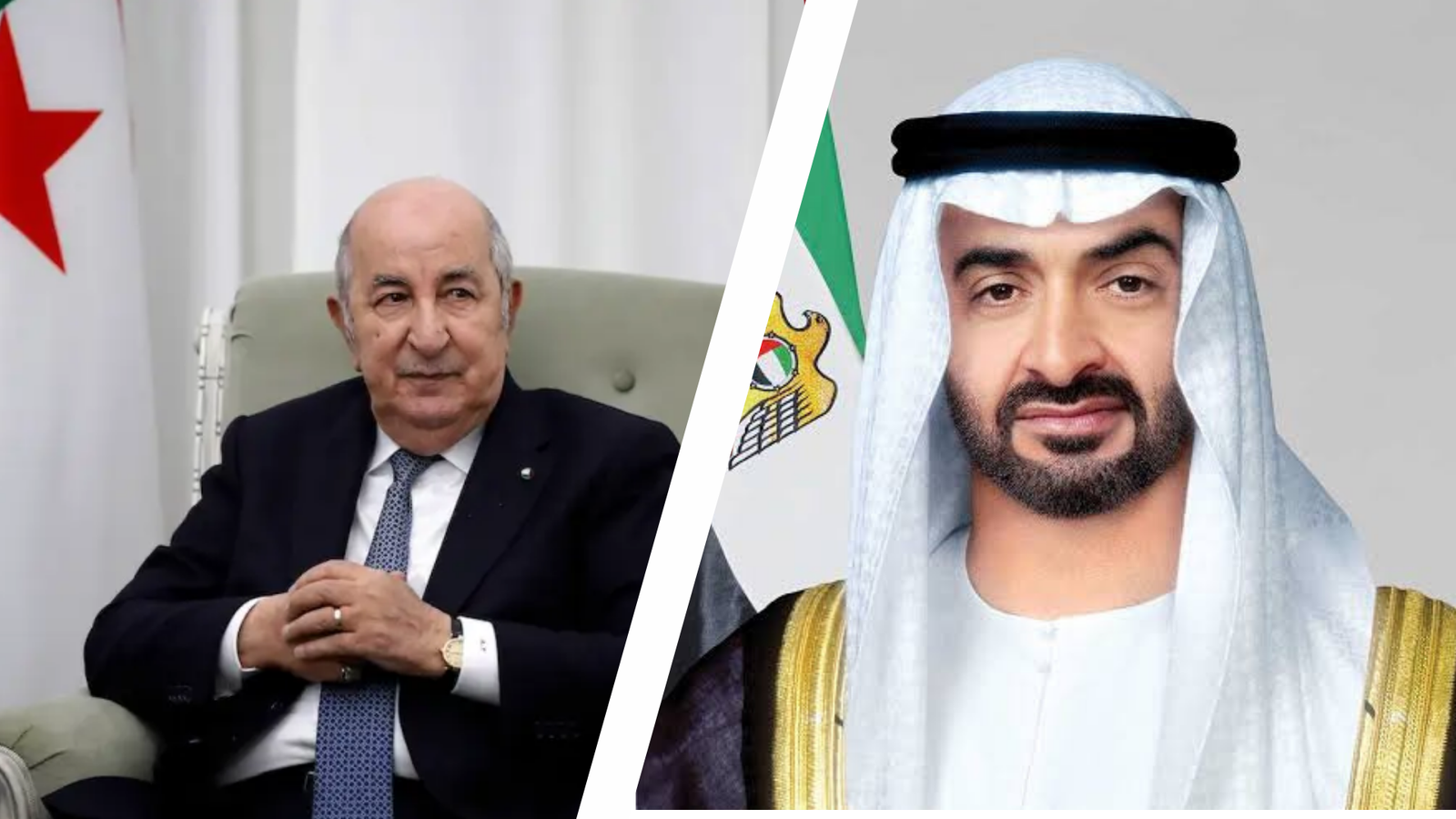
On 10 September 2026, Algeria’s Ministry of Foreign Affairs announced the severance of diplomatic relations with the United Arab Emirates, summoned UAE Ambassador Yousef Saif Khamis Subaa Al-Ali, and gave him 48 hours to comply with the decision and leave the country. The following day, Algeria’s Defence Ministry confirmed that all UAE-registered civilian and military aircraft would be banned from Algerian airspace with effect from midnight on 11 September 2026, with a transitional exemption permitting commercial flights to and from Algiers airport until the end of the year, when the current bilateral air services agreement expires. Emirates airline has since confirmed it will end its Algiers service, with the final flight scheduled for February 2027.
The rupture between two states that were among the founding partners of the Arab diplomatic order is not a bilateral aberration. It is a symptom of a deeper fracturing within the Arab and Muslim world, a fracturing driven by fundamentally divergent visions of regional order, the Palestinian cause, and the proper relationship between the Arab states and Israel. Understanding why Algeria severed ties with the UAE requires understanding what the two countries have come to represent as competing models of Arab foreign policy in the post-Abraham Accords era.
A Partnership Built on Shared Identity, Broken by Divergent Strategy
Algeria was among the first Arab states to recognise the UAE after the federation was established in 1971. For decades, the relationship rested on the foundations of shared Arab and Islamic identity, complementary economic interests, and formal cooperation structures including a joint ministerial committee established in 1984. In February 2026, Algeria took a significant preliminary step by initiating procedures to cancel the bilateral air services agreement signed in Abu Dhabi in May 2013, signalling that the diplomatic break now formalised had been under consideration for some time.
The Algerian Foreign Ministry’s statement cited “provocative and hostile acts” by the UAE, noting that Algeria had “exhausted all means of preserving bilateral relations” and had “spared no effort to draw the Emirati side’s attention to, and to warn it against, the dire consequences that could result from its regrettable and unjustified conduct.” The UAE expressed regret and said it hoped the decision would prove temporary, reaffirming its appreciation for “the brotherly Algerian people.” UAE adviser Anwar Gargash responded that relations should rest on “rationality and clarity.” The specific proximate trigger for the 10 September decision has not been publicly disclosed by either government.
The Accumulated Grievances: Six Structural Fault Lines
Whilst the immediate catalyst remains formally undisclosed, the structural fault lines driving the rupture are extensively documented and have been accumulating since at least 2020.
The Abraham Accords and Palestinian Cause
The single most consequential rupture in the relationship was the UAE’s normalisation of relations with Israel under the US-brokered Abraham Accords in August 2020. For Algeria, where the Palestinian cause is constitutionally enshrined and politically sacred, the Accords represented a fundamental betrayal of the longstanding Arab consensus that normalisation should follow the establishment of a Palestinian state. President Tebboune responded publicly that he did not favour “this rush toward normalisation.” The UAE’s subsequent deepening of economic, diplomatic, and defence ties with Israel, and its active encouragement of other Arab states to follow suit, has been a persistent source of bilateral friction. Algerian authorities have alleged that the UAE, alongside Morocco and Israel, has pursued a coordinated strategy to isolate Algeria regionally.
Libya
In Libya, the UAE backed General Khalifa Haftar’s 2019 military offensive against the UN-recognised Government of National Accord in Tripoli, providing air support and military equipment. Algeria, which shares a 982-kilometre border with Libya, opposed any military solution and advocated for a political settlement. The presence of UAE-backed forces operating along Algeria’s eastern border constituted, in Algiers’ assessment, a direct security threat. The two countries have backed opposing Libyan factions throughout the conflict’s evolution.
Sudan
In Sudan, where a devastating civil war has killed hundreds of thousands and created one of the world’s worst humanitarian crises since April 2023, Algeria backed the Sudanese Armed Forces under General Abdel Fattah al-Burhan. The UAE has been widely accused, including by the Sudanese government, of providing logistical and military support to the paramilitary Rapid Support Forces (RSF) led by General Mohamed Hamdan Dagalo. During Burhan’s visit to Algiers in January 2024, Tebboune reiterated Algeria’s support for Sudan “in resisting hostile forces.” Sudan’s own severing of ties with the UAE over the RSF allegation in January 2025 directly informed Algerian calculations.
The Sahel and Western Sahara
The UAE has expanded its diplomatic and commercial presence across the Sahel, including in Mali and Niger, where Algeria has traditional security interests along its 1,400-kilometre southern border with Mali. Algeria views UAE engagement in the Sahel as encircling its strategic periphery and as part of a broader pattern of destabilisation. In Western Sahara, the UAE opened a consulate in the disputed territory and provides active diplomatic support to Morocco’s sovereignty claim. Algeria supports the Polisario Front’s right to self-determination and has severed its own diplomatic relations with Morocco since 2021. The UAE’s alignment with Morocco is therefore viewed by Algiers as a direct and hostile act, representing an alliance against Algerian regional interests.
Alleged Internal Interference
Algerian authorities have publicly accused the UAE of supporting the Movement for the Autonomy of Kabylia (MAK), a separatist organisation in the Kabylie region that Algeria designates as a terrorist organisation. The allegation of external support for a domestic separatist movement represents the most acute dimension of the bilateral dispute, touching directly on state sovereignty and internal security. The UAE has denied these allegations.
Media and Cultural Interference
Relations were further strained by a controversy involving UAE-based Sky News Arabia, which broadcast an interview with historian Mohamed Amine Belghit in which he made controversial remarks questioning the existence of Algeria’s indigenous Amazigh culture. Algerian state television characterised the broadcast as a hostile media campaign. Belghit was subsequently jailed in Algeria before being pardoned by Tebboune. The episode crystallised longstanding Algerian concerns about UAE-funded media being deployed against Algerian national narratives.
Tebboune’s Characterisation: “Wherever They Set Foot, Blood Flows”
Algeria’s position has been articulated with unusual directness by President Abdelmadjid Tebboune. In a nationally televised interview in July 2026, Tebboune stated that an unnamed “micro-state” or “statelet” was seeking to destabilise countries across the region, citing Libya, Mali, and Sudan as specific examples. “Wherever they set foot, blood flows,” he said. “We want them to stay away, so that blood does not flow in our country.” He added that Algeria could have broken diplomatic relations much earlier but had refrained in order to avoid deepening Arab world divisions. The September decision represents the conclusion that this restraint had been exhausted.
The Airspace Dimension: Strategic and Economic Implications
The closure of Algerian airspace to UAE-registered civilian and military aircraft is not merely symbolic. Algeria occupies a strategically significant position in the air corridors connecting the Gulf to West Africa and southern Europe. UAE military aircraft operating in the Sahel theatre, including logistical support flights, will need to route around Algerian territory. For Emirates airline, the largest commercial carrier operating between the UAE and North Africa, the closure has direct commercial consequences. The airline has confirmed the cessation of its Algiers service from February 2027.
The aviation dimension also reflects a broader pattern. Algeria’s February 2026 initiation of procedures to cancel the 2013 bilateral air services agreement demonstrated that the airspace closure was not an improvised retaliatory measure but a planned and calibrated escalation consistent with a deliberate strategy of progressive diplomatic disengagement.
Wider Regional Implications
The Algeria-UAE rupture cannot be assessed purely as a bilateral matter. It reflects a broader divergence in regional foreign policy priorities that has been building across several Arab states since 2020, accelerated by the Gaza conflict and the deepening disputes over the Sahel. At the heart of that divergence is the question of the Abraham Accords. The UAE’s decision to normalise relations with Israel in August 2020 was welcomed in Washington and Tel Aviv, but it was experienced across much of the Arab and Muslim world as a departure from the longstanding consensus that recognition of Israel should follow, not precede, the establishment of a Palestinian state. For many governments and populations, the Accords did not represent a pragmatic adjustment to regional realities. They represented a unilateral abandonment of a collective position that had bound Arab diplomacy together for decades. That sense of abandonment has not dissipated with time; it has deepened as Israeli settlement expansion has accelerated and the Gaza conflict has intensified. Algeria, whose constitution enshrines support for the Palestinian cause and whose historical identity is inseparable from anti-colonial struggle, has been among the most consistent voices in articulating this dissatisfaction. The severance of ties with the UAE is, in part, the formal diplomatic expression of that dissatisfaction.
The consequences for the Sahel are immediate and practical. Severing ties with the UAE removes one of the few diplomatic channels through which competing external actors in the region might have engaged Algerian concerns directly. It also increases the risk of parallel and uncoordinated interventions in an already fragile security environment. Both Algiers and Abu Dhabi have genuine interests in Sahel stability; the absence of a direct diplomatic relationship makes managing those overlapping interests considerably harder.
The pattern is also notable in a broader context. Somalia cancelled agreements with the UAE in January 2025. Sudan broke diplomatic relations over allegations of UAE support for the RSF, the paramilitary force whose campaign in Darfur and Khartoum has produced one of the most severe humanitarian crises of the 21st century. The UAE categorically rejects these allegations and has consistently denied providing financial or logistical support to the RSF. The allegations nonetheless remain a significant feature of the international debate surrounding the Sudan conflict, cited in UN panel reports and by the Sudanese government, and they have materially shaped how several African and Arab states view UAE regional conduct. For many in the region, these episodes raise questions about the long-term costs of a model of external engagement that, whatever its intentions, has generated deep mistrust in multiple capitals. Algeria’s decision to sever ties adds a further African diplomatic capital to a list of strained relationships, and reflects a broader unease about the direction of UAE regional policy that Abu Dhabi will need to address if it wishes to rebuild its standing across the wider Arab and African world.
Strategic Outlook: Costs of Rupture and the Case for Dialogue
Both Algeria and the UAE have significant interests in a stable, cooperative Arab regional order. Algeria is one of Africa’s largest economies, a major gas supplier to Europe, and the dominant security actor across the Maghreb and into the Sahel. The UAE is one of the world’s most dynamic commercial and diplomatic hubs, a major investor across Africa, and a state with substantial influence in the Gulf and beyond. A sustained rupture between two such significant actors imposes real costs on both, on their bilateral commercial and people-to-people ties, and on the capacity of the broader Arab world to manage shared challenges collectively.
Three things warrant attention in the coming months. First, whether the end-of-year deadline for the commercial flight exemption is extended, which would signal that both governments see value in preserving at least a minimal operational channel. Second, whether backchannel diplomatic engagement, potentially mediated by a third party with credibility in both capitals, can begin to address the specific grievances, particularly those relating to the Sahel and alleged internal interference, that are most acute for Algeria. Third, whether the UAE takes any steps to address the conduct that has generated friction, not as a capitulation to Algerian pressure, but as a recognition that its regional relationships function better when they are built on reciprocal respect for national sovereignty and non-interference.
Algeria and the UAE were once close partners, bound by shared identity, complementary interests, and a commitment to Arab solidarity. The history that made this rupture painful is also the foundation on which a future reconciliation could be built. The UAE’s own expression of hope that the break would prove temporary reflects an awareness that the relationship has value worth preserving. For that hope to be realised, both governments will need to find a way to address the substantive disagreements, not merely the diplomatic form, that produced it. The cost of continued estrangement, for both countries and for the broader regional order they are part of, is high enough to make that work worth undertaking.