On 31 August 2026, officials from Israel and Greece signed an air-defence agreement in Israel that Israel’s ministry called the largest defence export deal in the history of the two countries’ relations. Israel’s Ministry of Defence director general, Amir Baram, and his Greek counterpart, Ioannis Bouras, put their names to a government-to-government contract worth roughly €3bn ($3.5bn). It is a layered air-defence network built around Israeli missile, radar and command-and-control systems. Athens calls it “Achilles Shield.” Israel calls it a milestone for its arms industry.
The deal is presented as a neutral piece of modern procurement, a Mediterranean country protecting itself against drones and missiles. It deserves a harder look, because of who is selling, what the sale is for, and what it does to an already fragile neighbourhood.
What Greece has bought in the Achilles Shield deal
The contract is not a single product. It is valued at €3.035bn and covers Barak MX, David’s Sling and Spyder air-defence systems, with contributions from Israel Aerospace Industries and Rafael. A separate supplementary agreement worth about €26m, covering Rafael’s Drone Dome counter-drone technology, was signed the same day. The programme’s stated aim is a range of weapons creating overlapping shields across all Greek territory, tied together by an integrated command-and-control system. The name is deliberate. In Homer, the shield of Achilles had five layers, and the Greek programme borrows that image.
The timeline and structure matter. Athens approved the purchase on 23 July and said the whole programme should be ready 35 months from then, delivered in stages. Final negotiations settled a requirement for at least 25% Greek industrial participation and provisions on source code. The extent of Greek access to that code has since been disputed: Israel’s ministry says the Greek-developed command-and-control code will remain under exclusive Greek control, while the proprietary code inside the Israeli interceptors stays Israeli. This is what separates the deal from a one-off weapons sale. It integrates Greek and Israeli military systems at a deep technical level, and it creates dependencies that last decades.
It also sits inside a much larger spending drive. Athens plans to spend about €28bn by 2036 on a broader modernisation programme that includes the Israeli system, up to 40 US F-35 jets, and frigates from France and Italy. Even analysts sympathetic to Greece’s position acknowledge the escalatory dynamic. One defence-industry assessment warned that the programme is feeding a spiral of rising tension between Athens and Ankara.
A deal sold on the strength of the battlefield
Israeli officials have been unusually open about what they are selling and why. Baram said the agreement reflects Israel’s technological edge and the proven track record of its defence systems in the field. In the Israeli ministry’s own words, growing defence exports is a key driver of IDF force buildup, of Israel’s foreign policy influence, and of a stronger defence industry and economy.
That candour is revealing. “Combat-proven” is a marketing term, and in Israel’s case the proving ground is a war that UN-appointed investigators, major human rights organisations and many legal scholars describe as genocide in Gaza. The scale of the death and destruction in Gaza is not in dispute, and it has made Israeli arms exports a moral question as well as a commercial one. When a ministry advertises its systems as validated by the last two years of war, every buyer takes part in that economy, which funds production lines and rewards the industry running them.
Public opinion in Greece reflects the discomfort. As in several European countries, many Greeks oppose Israel’s actions in Gaza and the deepening of ties with Israel. Athens has also signed this deal while Greek dockworkers and activists have, in other contexts, protested the transit of military cargo to Israel. The Greek government is betting that security logic will outweigh that discomfort. The same discomfort was voiced in Turkish commentary, where some analysts argue the procurement makes Greece effectively co-responsible for Israeli actions in the West Bank and Gaza. That is an argument made to score points, but it will resonate with voters across the Mediterranean.
Why Ankara reads Achilles Shield as a threat
Turkey’s objections are not new, but the deal gives them fresh substance. Three features stand out.
Geography. The first elements are not going to be placed in Athens or Thessaloniki. Greece plans to deploy the system first in the northeast and on eastern Aegean islands close to the Turkish coast. Those are the islands Turkey says should remain demilitarised under the 1923 Lausanne and 1947 Paris treaties, a position Greece rejects, citing its right to self-defence. A modern air-defence umbrella over those islands would constrain Turkish air operations in the Aegean and extend Greek radar and missile coverage close to Turkey’s western coastline. In a crisis it would shape what Turkish aircraft and drones could do in contested airspace.
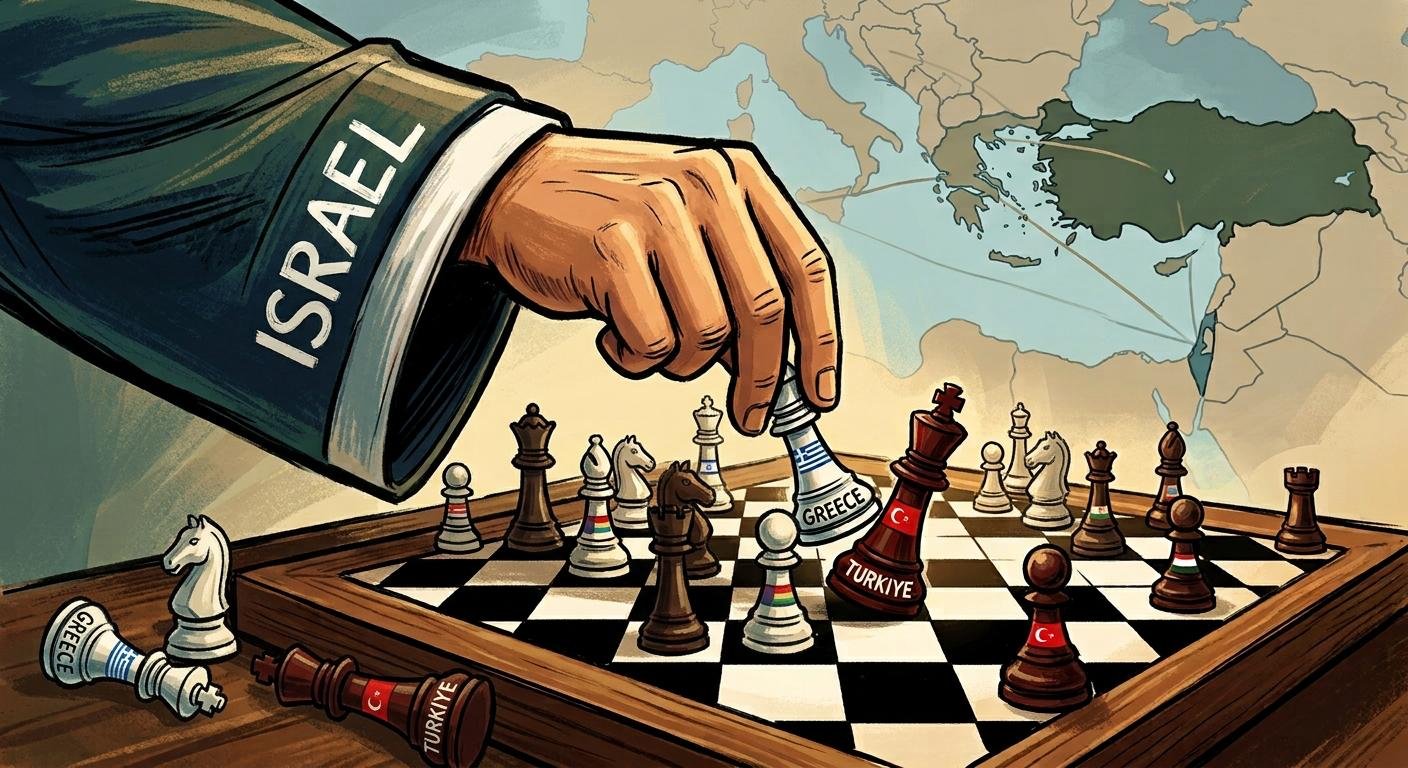
The strategic partner. Turkey does not view this as a bilateral Greek matter. The Israeli deal follows a joint military action plan for 2026, signed by senior officers of Israel, Greece and Cyprus last December, with commitments to joint air and naval exercises in the eastern Mediterranean. Turkey’s foreign minister, Hakan Fidan, has described the Greece-Cyprus-Israel trilateral as a security alliance aimed at Turkey, one that sought to draw a line through the eastern Mediterranean between Turkey and Egypt. Baram’s public vision, a security architecture stretching from India through the UAE to Greece and Cyprus, may be aimed at Iran, but Ankara sees a ring tightening around it.
Interoperability. Integrated command-and-control is the most consequential piece. Once Greek air defences share data and doctrine with Israeli systems, Turkey has to plan against a bloc rather than a single country. Turkish planners will worry about intelligence sharing, about Israeli access to Greek and Cypriot facilities, and about the political cover this gives Athens in disputes over maritime boundaries. Greece is also pressing a hard line elsewhere: Dendias has said that countries which threaten EU member states should not take part in the EU’s SAFE defence programme, a remark widely read as aimed at Turkey.
Turkey’s response so far
Ankara’s tone has hardened, though it has so far stopped short of direct threats. On 10 August, in a written reply to parliament, Defence Minister Yaşar Güler noted that Greece-Israel military cooperation had developed in recent years in defence industry, training, exercises and technology. Two days after the signing, Erdoğan answered for the first time without naming Israel, warning that Greece must abandon its wrong path. In earlier remarks he linked criticism of Greek spending to a pointed jibe: that a message sent from Kaş would be heard in Greece.
The legal backdrop is dangerous. Turkey never ratified UNCLOS and has warned, since a 1995 parliamentary resolution, that any extension of Greek territorial waters in the Aegean beyond six nautical miles would be a case for war. Add a new layer of military hardware on the islands, and the margin for miscalculation narrows. The two countries have come close to the brink before, notably in 1996 over the Imia/Kardak rocks and in 2020 during the Oruç Reis standoff. Both episodes were defused, but neither involved a Greek military so tightly meshed with Israel’s.
Turkey’s own rise also feeds this. Ankara has built its “Steel Dome” and a large domestic drone industry, and the two sides are now in a straightforward arms race. Greek analysts argue that this makes the Israeli shield a stabilising rather than provocative step. One Panteion University scholar contends that the programme is meant to make war a less attractive option for Turkey, not to prepare for one, and that Greece needs no Turkish consent to organise its defence under Article 51 of the UN Charter.
Defensive on paper, destabilising in practice
That argument deserves a fair hearing. Air-defence systems are, by design, defensive. Greece’s concern about missiles and drones is genuine, especially after the regional escalation involving Iran, and every sovereign state has the right to protect itself. Turkey’s own Aegean claims, and its “casus belli” threat, are hardly models of restraint.
But “defensive” is a label, not a guarantee. A shield that lets an air force operate without fear of retaliation can make a state more willing to take risks. When it is built by a partner with its own agenda against Ankara, and placed on islands that are the subject of a live sovereignty dispute, Turkey has reasonable grounds to treat it as part of a wider military posture. Security dilemmas work this way: each side’s defensive step looks offensive to the other, and the reply makes the first side feel less safe.
Israel’s role makes this worse. Jerusalem is not a disinterested supplier. Israeli officials have openly framed regional alliances as a way to extend influence, and relations with Turkey have collapsed over Gaza. Israel gains twice from the arrangement: it earns billions in revenue and it ties a NATO member’s neighbour more closely to its own strategic outlook, at a moment when it is isolated elsewhere. Athens, for its part, risks becoming a forward partner in a project it did not design, and tying its security to a government facing mounting international legal scrutiny.
The cost of the bet
Greece has made a calculated choice, and its leaders will argue that no alternative offered comparable systems on this timeline. That may be true. But the costs fall beyond the contract value. They include reputational damage among Greek citizens uneasy about arming and training alongside Israel’s military, a more dangerous Aegean, and strategic dependence on a supplier whose conduct in Gaza has drawn growing condemnation.
For Turkey, the question is how to respond without feeding the spiral. Erdoğan’s rhetoric suggests Ankara will protest loudly, press its demilitarisation case, and accelerate its own procurement. The better outcome would be a revival of the quiet confidence-building channels that kept Greek-Turkish relations manageable in recent years. That outcome gets harder with every new radar site and interceptor battery in the eastern Aegean.
The Shield of Achilles: mythological symbolism
In Homer’s Iliad, the Shield of Achilles was a magnificent piece of armour forged by the god Hephaestus. It was intricately detailed, representing the entire world and cosmos, and it armed the hero for his return to battle. The Greek name for the programme is a reminder that Achilles’ shield was forged for a war. By invoking this name, Greece symbolises a return to ultimate protection and formidable defence. Yet Homer’s Hephaestus admits that he cannot hide Achilles from death, and the shield did not save him. Greece and Turkey are NATO allies and should be able to settle their disputes at a table. A shield built with Israeli technology, and sold on the strength of what Israeli weapons have done in Gaza, brings that table no closer.