
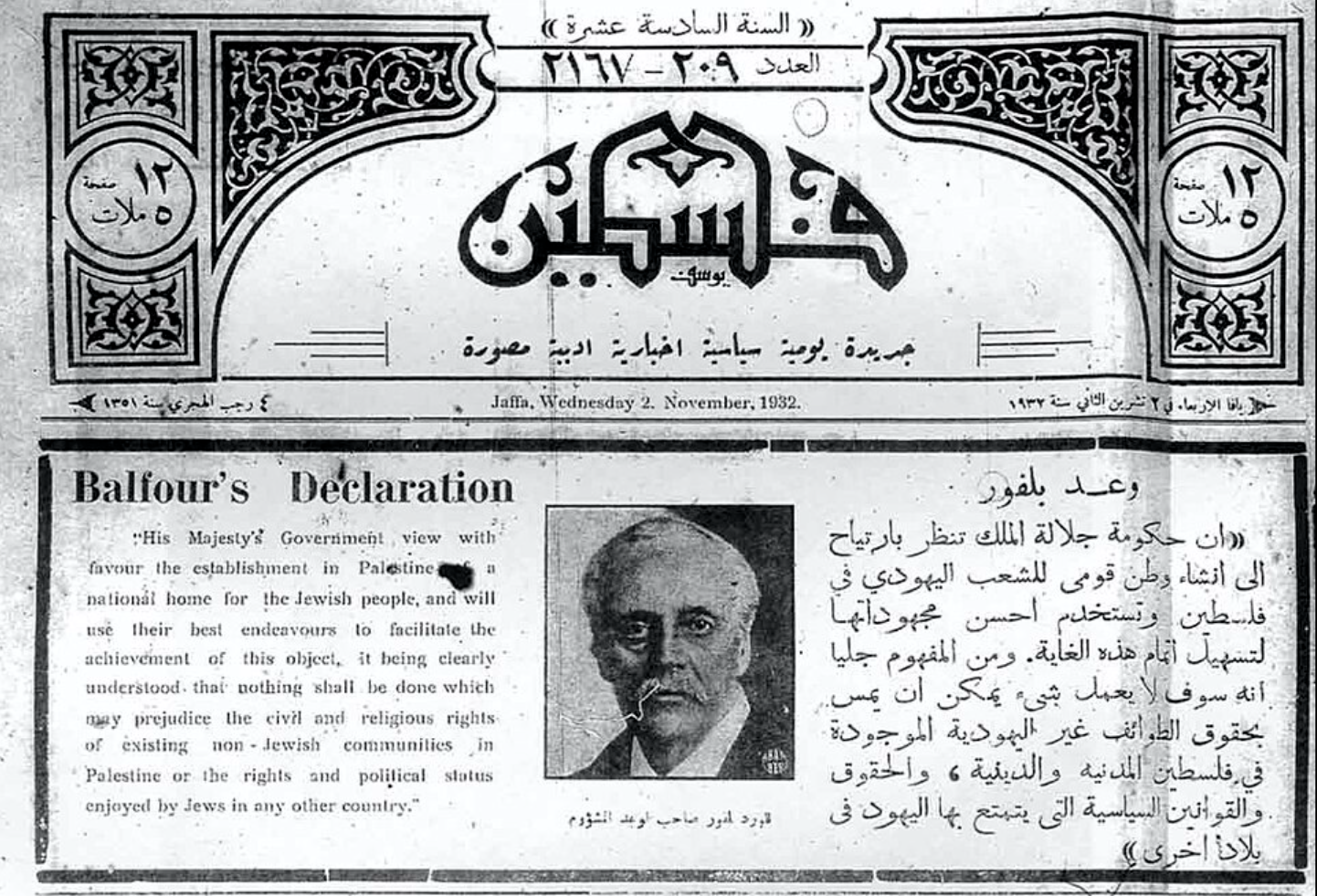
The Balfour Declaration of 2 November 1917 is often read in Britain as a short, calculated note of sympathy addressed to Lord Walter Rothschild. Sixty-seven words long, written by Foreign Secretary Arthur Balfour on behalf of the British War Cabinet, it stated that His Majesty’s government viewed with favour the establishment of a national home for the Jewish people in Palestine, provided nothing was done to prejudice the civil and religious rights of existing non-Jewish communities.
By referring to the indigenous majority simply as “existing non-Jewish communities” and limiting their protection to civil and religious matters, London withheld political sovereignty from the people who actually lived there. Late Ottoman demographic estimates and early British Mandate records place Palestine’s population around that period at roughly 689,000 people, made up of about 525,000 Muslims, 70,000 Christians, and 94,000 Jews. Around 86 percent of the population was Arab. A declaration that granted national aspirations to a minority and to incoming settlers while reducing the majority to a religious and civil footnote was never a neutral diplomatic text. It was an instrument of imperial control.
To grasp its real function, the declaration has to be read alongside the wider collapse of the Ottoman Empire and the strategic pressures facing Britain in late 1917. It was not simply a step toward creating a state in Palestine. It was part of a broader effort to break up interconnected Muslim-governed territories, prevent a unified regional order from emerging after the war, and lock the Levant and Mesopotamia into European spheres of influence.
Imperial Survival and Wartime Calculation
By the autumn of 1917, Britain was stretched thin across multiple fronts. Years of industrial warfare in Europe had drained British finances, pushing national debt from roughly £650 million in 1914 toward more than £7.7 billion by 1919. Russia was in political turmoil following the revolutions of 1917, raising fears in London that the Eastern Front would collapse and free German divisions to press westward.
In that climate, British ministers treated diplomacy as a way to buy leverage without spending fresh troops. Supporting a Zionist project in Palestine served three overlapping aims:
- Imperial geography: Palestine sat directly beside the Suez Canal, Britain’s vital maritime link to India and its wider eastern empire. Under the secret 1916 Sykes-Picot Agreement with France, Palestine had been slated for a form of international administration. By 1917, Prime Minister David Lloyd George and senior strategists wanted tighter British control closer to Egypt. Backing a Jewish national home under British patronage gave London a rationale to argue against internationalisation and keep France out of the territory’s direct administration.
- Wartime leverage across the major Allied powers: Fighting an exhausting global war, senior officials in London sought to tap into influential Jewish networks in both the United States and Russia to secure British strategic interests. In Washington, British ministers calculated that backing Zionism would mobilise sympathetic figures near President Woodrow Wilson to solidify American financial and military backing for the Allied cause. In Petrograd, where revolutionaries of Jewish heritage such as Leon Trotsky held senior posts in the new Bolshevik leadership, Whitehall hoped that endorsing a Jewish homeland in Palestine would give Russia’s new rulers an incentive to remain in the war against Germany. Regardless of how those leaders ultimately responded, the episode laid bare Britain’s willingness to trade away the political future of Palestine as a bargaining chip for its own wartime survival.
- Ideology inside Whitehall itself: Figures such as Lloyd George and Balfour brought a Victorian Christian Zionist outlook into government, viewing the restoration of Jews to Palestine through a biblical lens that sat comfortably alongside British expansionism. Lobbying by Walter Rothschild and Chaim Weizmann mattered because it spoke to ministers who already saw strategic value in the project. The declaration did not come out of a secret financial takeover of the British treasury; it came out of British imperial self-interest meeting a movement that needed a great-power sponsor.
Contradictory Pledges and the Break-Up of the Levant
The Balfour Declaration was only one piece of a wider set of wartime promises that pulled in opposite directions. Between July 1915 and March 1916, Sir Henry McMahon, Britain’s High Commissioner in Egypt, exchanged letters with Hussein bin Ali, the Sharif of Mecca. Those letters encouraged Hussein to lead an Arab revolt against Ottoman rule, holding out the prospect of Arab independence across large parts of the Arab provinces once the war ended, subject to reservations that later became the subject of sharp dispute.
Arab forces rose against Istanbul, tying down Ottoman garrisons and aiding Allied advances. Yet Britain had already concluded the secret Sykes-Picot Agreement with France in May 1916 to divide Ottoman Arab lands into zones of direct control and influence. Adding the Balfour Declaration in November 1917 made those conflicting commitments even harder to reconcile. Promises made to secure wartime cooperation were set aside once imperial borders were drawn.
When the Ottoman Empire fell in 1918, the region did not move toward self-rule as a connected whole. Instead, Britain and France used the League of Nations Mandate system to turn wartime partition lines into formal borders. Syria and Lebanon went under French mandate; Iraq, Transjordan, and Palestine came under British mandate. Historically linked trade routes, towns, and communities were split across separate administrations. Then, in 1924, the abolition of the Caliphate in Ankara ended the last institutional symbol of a wider Sunni political order.
Containing the Hashemites
The treatment of Sharif Hussein bin Ali and his sons shows how Britain handled the local leaders it had used during the war. Hussein refused to endorse peace terms that entrenched European mandates and conflicted with his expectations of Arab independence. Once he ceased to be useful as a wartime lever, British backing faded. Between 1924 and 1925, Abdulaziz Ibn Saud conquered the Hejaz, forcing Hussein into exile and ending the brief rule of his eldest son, Ali, as King of Hejaz.
For Hussein’s other sons, Britain arranged thrones inside territories it controlled or influenced. Faisal, driven out of Damascus by French forces in 1920, was placed on the throne of Iraq in 1921 under British oversight. That monarchy struggled with domestic opposition over its ties to Britain and ended in the bloody July 1958 coup that killed the royal family. Abdullah was made ruler of Transjordan, a newly carved territory east of the Jordan River that acted as a buffer near Palestine. Assassinated in Jerusalem in 1951, Abdullah left a line that still rules Jordan today, the one Hashemite throne that endured.
Engineering Dependency Across a Divided Region
The Balfour Declaration cannot be separated from the wider mechanics of British imperial statecraft across the Muslim world. For centuries, large swathes of Muslim lands from the Balkans and Anatolia to the Levant, Mesopotamia, and the Hijaz had operated within broad imperial frameworks that allowed movement, trade, legal continuity, and shared political identity across wide geographies. From London’s perspective, any large, self-governing Muslim bloc straddling Eurasia and Africa posed a structural threat to British maritime supremacy, oil access, and imperial communications.
Dismantling that order did not rely on brute force alone. It relied on division, dependency, and carefully managed rivalries. By breaking the Levant and Mesopotamia into separate mandates, Britain turned neighbours with shared histories into rival states with competing border grievances and unequal access to resources. By drawing borders that cut across tribal domains, agricultural basins, and commercial routes, Whitehall ensured that newly formed states remained weak on their own and reliant on outside security guarantees.
Equally decisive was how London managed leadership and legitimacy. Where local rulers pushed for genuine sovereignty or pan-Islamic solidarity, Britain either bypassed them, backed rival claimants, or tied their survival to imperial patronage. By ending the Caliphate’s institutional reach, fragmenting Arab political centres, and dividing one of the spiritual epicentres of Islam, Palestine, Britain hollowed out the capacity of the Muslim world to act as a single strategic actor. Every fracture served a clear imperial purpose: smaller, divided states are far easier to police, influence, and align with Western strategic interests than a united region.
The Map Still Bleeds Where the Pen Cut
Flags changed, mandates expired, and imperial garrisons eventually packed their bags, yet the political map drawn in London and Paris still governs the daily realities of millions. A single pen stroke in Whitehall turned a living, interconnected region into a puzzle of permanent friction, proving that empire rarely ends when the troops leave; it endures in the borders it draws and the divisions it leaves behind.