For decades, Israeli geopolitical strategy aimed to transform Tel Aviv into the non-negotiable economic, technological and security core of a restructured Middle East. By leapfrogging the Palestinian question through economic diplomacy, transnational infrastructure corridors and bilateral normalisation accords, Israeli policymakers sought to reorder the region’s geoeconomic architecture.
However, the real-world trajectories of regional integration have sharply diverged from this hub-and-spoke blueprint. Rather than embedding Israel as an indispensable transit hub, the geopolitical shocks following October 2023 and subsequent regional escalations, including the war on Iran launched by the United States and Israel on 28 February 2026 and the resulting disruption to shipping through the Strait of Hormuz, catalysed an alternative security and infrastructural architecture across the Middle East. Regional actors, faced with supply-chain vulnerabilities, maritime choke-point disruptions and unpredictable external guarantees, have increasingly favoured intra-regional defence arrangements, non-correlated trade routes and sovereign strategic reserves that bypass Israel entirely.
The Architectural Strategy: From Peres’s 1993 Vision to Netanyahu’s UN Map
A Thirty-Year Ambition for Regional Centrality
The strategy to construct an Israeli-centric regional order is not a recent development; it represents the culmination of a thirty-year conceptual evolution. The foundational paradigm was articulated in 1993 by then-Foreign Minister Shimon Peres in his book The New Middle East, published during the optimism of the Oslo Accords. Peres envisioned a cooperative economic bloc where Israeli technological expertise would combine with Arab labour to transform the region into a prosperous, interconnected marketplace.
However, over the subsequent three decades, this vision underwent a fundamental doctrine shift under Prime Minister Benjamin Netanyahu. Where Peres viewed economic integration as a means of building peace, including with the Palestinians, Netanyahu repurposed the concept into a strategy of containment and circumvention, seeking peace without Palestinian statehood.
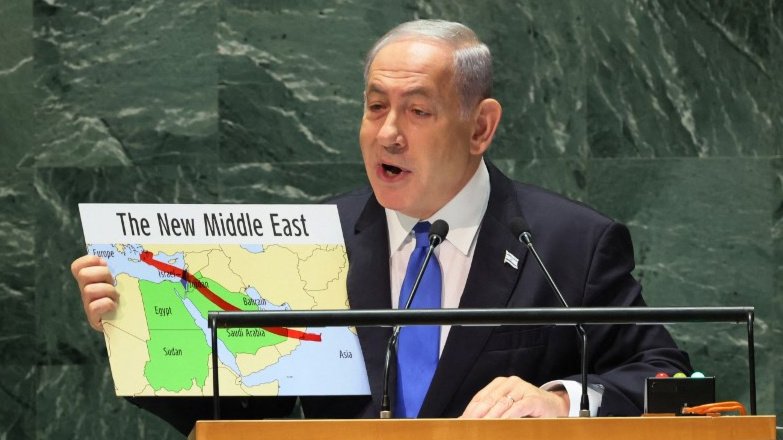
This ambition reached its explicit visual climax when Netanyahu stood before the United Nations General Assembly in September 2023, holding a marker and physically drawing a red line across a map labelled the ‘New Middle East’. The line traced a seamless trade route linking Asia through the UAE, Saudi Arabia, Jordan and Israel directly to Europe. Crucially, the map made no reference to the West Bank and Gaza, territories that Israel captured in 1967 and is still occupying, and instead appeared to show Israel encompassing them. This gesture signalled a multi-decade calculation: that Israel could leverage its tech, military and diplomatic weight to permanently sideline the Palestinian issue and establish itself as the central, indispensable hub of the region.
This strategy relied on three interdependent pillars:
- The Abraham Accords Framework: Constructing direct bilateral economic, security and diplomatic bridges with the UAE and Bahrain, alongside North African nations, thereby creating a critical mass of diplomatic recognition without needing to end it’s territorial occupation.
- Infrastructure and Energy Connectivity (IMEC): Positioning Israel as the crucial land-bridge in initiatives like the India-Middle East-Europe Economic Corridor (IMEC). By funnelling trade, hydrogen pipelines and fibre-optic cables from Asia through the Arabian Peninsula and Israeli ports (such as Haifa) directly into Europe, Israel sought to establish itself as an indispensable trade artery between continents.
- Geoeconomic Bypass of Historic Gatekeepers: By funnelling East-West trade directly through Haifa, Israel sought to simultaneously marginalise Egypt’s reliance on the Suez Canal and bypass Turkey’s traditional Anatolian transit routes, altering the regional balance of power.
Reality vs. Strategy: The Multi-Front Conflict and Structural Realignment
The assumption that regional integration could proceed unhindered while the core political conflict remained frozen was disrupted by the events of October 2023 and the subsequent multi-front regional escalation. Instead of consolidating a centralised, Israeli-led economic web, the cascading conflict exposed structural vulnerabilities in the proposed infrastructure and triggered defensive realignments across neighbouring states.
The Fragility of Transnational Infrastructure
Transnational economic corridors require high levels of sustained geopolitical predictability. The disruption of Red Sea shipping lanes, military friction along border corridors and long-range strike capabilities across the region highlighted the inherent risk of centralising critical supply chains through high-friction transit zones.
Rather than cementing the IMEC transit route, the conflict emphasised the hazards of relying on single point-of-failure corridors, accelerating the search for modular, multi-modal trade alternatives that do not depend on Israeli ports.
Shift in Security Doctrines: Regional Autonomy over External Umbrellas
As military operations expanded across Gaza, Lebanon, Syria and Iran, regional capitals reassessed their long-term national security calculations:
- Sovereignty and Buffer Redefinitions: Israeli military doctrines shifted towards expanding buffer zones and maintaining continuous offensive operational capabilities across neighbouring territories. This operational pivot has left Israel holding territory in Gaza, Lebanon and Syria, and generated friction with Egypt, where former officials and commentators have questioned whether reported Israeli fortifications near Rafah are compatible with the security arrangements of the 1979 peace treaty.
- Diversification of Security Partnerships: Reliance on external security guarantees or single regional powerhouses gave way to multi-vector hedging. Middle Eastern states accelerated defence collaboration with global and regional powers, including China, Turkey and South Asian partners, to build resilient, indigenous security umbrellas.
The Emergence of the Alternative ‘New Middle East’
The true structural reordering of the Middle East is not occurring around a single non-Arab technology hub, but through a network of intra-regional partnerships and circumvention infrastructure designed for stability and survival.
Key Dynamics of the Realignment
- Intra-GCC and Circumvention Logistics: To mitigate choke-point risks along key maritime straits, notably Hormuz, Gulf Cooperation Council (GCC) states have reinvigorated internal interconnectivity. Initiatives include building a Gulf-wide railway that is roughly half complete, utilising East-West pipelines to bypass maritime bottlenecks, discussing shared strategic commodity reserves and accelerating joint economic and infrastructure projects.
- Anatolian and Mesopotamian Transit Corridors: Alternative trade networks are gaining momentum. The Iraq-Turkey Development Road project, which has yet to be built but gained five new Iraq-Turkey agreements in July 2026, combined with the planned revival of the Iraq-Syria oil pipeline to the Mediterranean and bilateral energy supply agreements between Turkey and Syria, Egypt and Syria, and Turkey and Egypt, could re-establish Anatolia and the Levant as major overland arteries connecting the Persian Gulf to European markets.
- Interregional Defence Alliances (The Mecca Agreement): A crucial milestone in this structural shift was the signing of the Mecca Joint Defence Agreement between Turkey, Saudi Arabia and Pakistan. By integrating Pakistan, a major nuclear-armed South Asian state, alongside the military capacity of Turkey and the financial weight of Saudi Arabia, this pact represents a move towards an autonomous regional defence posture. Rather than relying on Israeli technology or Western guarantees, regional states are creating self-contained deterrence frameworks capable of protecting sovereign interests.
- Pragmatic Diplomatic Consolidation: Former regional rivals, such as Cairo, Ankara, Doha and Riyadh, have placed longstanding ideological disputes on hold to establish pragmatic, strategic partnerships. Joint air exercises between Egypt and China in 2025 and 2026, the first naval exercise between Egypt and Turkey in 13 years (2025) and the Turkey-Egypt High-Level Strategic Cooperation Council, which has met twice, in Ankara in 2024 and in Cairo in 2026, indicate a growing consensus: regional stability must be managed internally through collective diplomacy rather than through external, exclusionary frameworks.
Strategic Outlook: From Single-Hub Dominance to Regional Circumvention
The strategy to build a ‘New Middle East’ by positioning Israel at its core relied on a fundamental premise: that economic integration could permanently outpace unresolved political conflicts.
The empirical reality of the region has proved far more complex. While Israel remains a formidable military power, its attempt to unilaterally dictate the geoeconomic map of the Middle East has inadvertently accelerated the formation of alternative regional alliances. Middle Eastern states are building a network of trade, energy and defence corridors designed to operate around friction points rather than through them.
Ultimately, a sustainable regional architecture cannot be achieved by sidelining core political realities. The future of Middle Eastern stability relies not on single-hub dominance, but on balanced, sovereign intra-regional cooperation that addresses underlying conflicts rather than attempting to bypass them.