
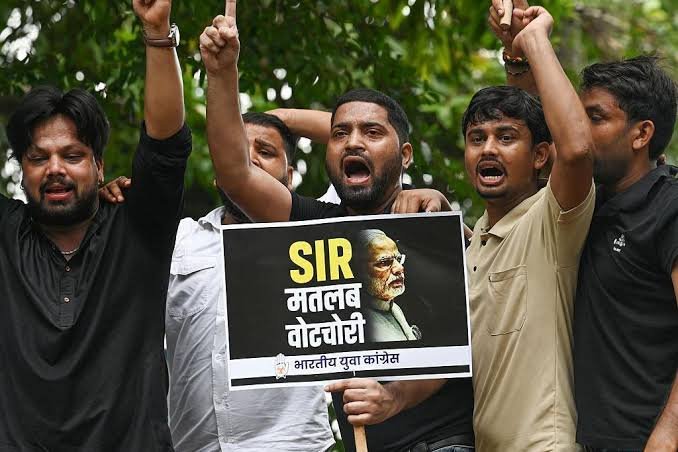
India’s biggest electoral-roll overhaul is now a national political crisis. Protesters have taken to the streets, the Supreme Court has demanded answers, and millions of people removed from the rolls are waiting to learn whether they can get back on them.
The scale of the purge
The exercise is called the Special Intensive Revision (SIR). According to an AFP report, the register held about 970 million names before the overhaul, and more than 130 million have been removed. The reported breakdown is over 20 million entries classed as dead voters and another 90 million classed as absent, relocated or otherwise ineligible. Those two categories add up to about 110 million, not 130 million. The remainder, presumably duplicates and other categories, has not been itemised in the coverage reviewed. The headline figure also comes from press tallies rather than a single official national count. India has no centralised electoral roll, so the total is compiled from state-level data.
The revision began last year in Bihar. The draft roll published there on 1 August 2025 listed 22.3 million voters as deceased, 36.3 million as permanently shifted and 701,364 as enrolled in more than one place, with 6.56 million names deleted in all. The exercise later expanded to other states. In West Bengal, a petition by the Trinamool Congress MP Derek O’Brien said 5,820,898 names were deleted from the draft roll published on 16 December 2025, without notice or a personal hearing. AFP’s account, citing a New York Times investigation, puts West Bengal’s total removals at about nine million names.
Who has been hit
The central allegation is that Muslims, India’s minority of roughly 200 million people, have lost votes at a higher rate than other groups. AFP’s report says Muslims appear to have borne a disproportionate share of the deletions. Other findings point the same way. Early in the Bihar exercise, four districts with large Muslim populations, including Purnia (39 per cent Muslim), were among the ten with the most deletions. A New York Times review, described in the AFP report, found that nearly 2,000 objections were filed in one Karnataka constituency on a single day, overwhelmingly against Muslim voters, with five individuals filing almost half. The Economist has also reported on concerns about Muslim voters’ vulnerability to deletion and on the Form 7 objections used to challenge names.
The rhetoric around the exercise has sharpened these fears. BJP leaders have framed the revision as a campaign against “infiltrators”, language nominally aimed at Bangladeshi migrants but applied to Muslims generally. The same report says there is no strong evidence that the revision has found substantial numbers of foreign nationals. Critics also draw a parallel with Assam’s citizenship register, whose 2019 final list left nearly 2 million people at risk of statelessness, most of them Muslims.
How people are being removed
Former officials say the method itself is the problem. Ashok Lavasa, a former election commissioner, told reporters that earlier revisions relied on officials visiting homes to verify voters. In this one, citizens must prove their own eligibility, which is hard for people with poor records or no birth certificates. Repeated trips to election offices also cost low-income workers their wages. Algorithms have flagged tens of millions of entries for inconsistencies such as name variations, family details and age gaps between siblings. Former officials warn that clerical errors can become grounds for removal.
In Bihar, the opposition argued early on that the documentation rules would hurt the poor and minorities. As Reuters-syndicated coverage noted at the time, India has no unique national identity card, and Aadhaar, the widely used biometric ID, was not on the Election Commission’s list of accepted documents.
Appeals and a legal standoff
The most politically explosive fight is over appeals. West Bengal is the clearest example. The BJP won power there in May for the first time. The AFP report says the Supreme Court allowed voting to go ahead while millions of challenges remained unresolved, and of roughly 100,000 appeals decided so far, most ended with voters restored to the roll. That ratio is central to the opposition’s argument that many deletions were wrong.
The opposition has also told the court that deletions exceeded the BJP’s winning margins in 82 of its 207 seats, enough to affect control of the legislature. That is the opposition’s claim, presented in litigation, and it has not been adjudicated. A broader pattern is alleged too. One outlet reports that in several state constituencies, deletions exceeded victory margins. That outlet, Breakthrough News, is an advocacy publication, so this point should be treated cautiously until it is verified against official data.
A further dispute has emerged inside the Election Commission itself. Court-appointed officials approved reinstating 1.6 million voters, but the commission challenged their inclusion, blocking their return, according to its own court filing. A newspaper investigation then reported that two of the three election commissioners said they were not told the challenge was being filed. Reporting by The Indian Express, syndicated by Brit Brief, revealed multiple irregularities flagged in more than a dozen internal objections. Local media then reported that the commission had asked officers to review deleted-voter lists for mistaken removals.
The Supreme Court steps in
On Monday 5 October, the Supreme Court issued notices to the Modi government, the Election Commission and Chief Election Commissioner Gyanesh Kumar, expecting a “clear, transparent” response. Two petitions before it question the commission’s credibility and seek an independent inquiry into Kumar’s decisions on how the SIR was run. The lawyer Menaka Guruswamy, for one petitioner, told the court the deletions had undermined free and fair elections. Another advocate warned that if the rolls were not made fair, the country “will burn”. The next hearing is set for next week.
Protests and policing
The demonstrations are being driven by opposition parties and a youth-led movement. The Cockroach Janata Party, which led the summer unrest that forced out Modi’s education minister, has mobilised again to demand Kumar’s resignation. Thousands marched in Mumbai on Friday, and on 6 October 2026 the opposition INDIA bloc held a march in New Delhi.
Policing has drawn criticism. In the capital, hundreds of young people were put on police buses, and officers have been accused of sexually assaulting three journalists, an allegation Delhi police say they are investigating. Rohinton Nariman, a former Supreme Court judge, said the right to vote was “at great peril”.
The government’s and commission’s case
The Election Commission says the SIR is a clean-up of duplicate, dead and ineligible entries, and that it also removes “illegal infiltrators”. The BJP argues that opposition parties themselves long demanded cleaner rolls and are now politicising the process. The commission did not respond to repeated requests for comment from the outlets whose reporting is cited here.
These arguments have some substance. Indian rolls have long carried duplicates and the names of the dead, and the commission’s Bihar draft figures reflect that. A clean-up of this kind could in principle be legitimate. The dispute is over method, proportion and motive. Critics point out that the commission’s own appeals process is reversing many deletions, which suggests the initial removals were not all sound.
The institutional backdrop
Opposition parties say the safeguards around the commission have weakened. In 2023, Modi changed the commissioner selection committee to favour the government and passed legislation granting commissioners legal immunity. Chief Election Commissioner Gyanesh Kumar was selected by a panel headed by the prime minister, and the opposition alliance accuses the commission of colluding with the government in what it calls vote “chori”, or theft.
What to watch
Several things will decide how this plays out:
- The Supreme Court’s hearing next week, and whether it orders an independent inquiry or a pause on further deletions.
- The appeals backlog. Millions of cases remain undecided, and the outcome will show how many of the 130 million names were wrongly removed.
- Whether the commission’s internal rift widens, given reports that two of its three commissioners objected to its own legal challenge.
- An authoritative community-level breakdown. Until the commission or courts release verified data, the claim that Muslims were disproportionately affected rests on investigations and district-level patterns, not a complete count.
- Whether the movement sustains itself. The 2029 general election is far off, but upcoming state polls raise the stakes.
[Image Credit: BBC]
Shanti Sharma is a human rights activist and documentary script writer whose work focuses on violence, social conflicts, and issues of justice in contemporary societies. Her writing combines field-based perspectives with critical analysis of political and social developments affecting marginalized communities. She is a research coordinator at iResist, a London based Human Rights advocacy platform.