
Japan has been part of Bangladesh’s development story for decades. The bridges, roads, railways and other projects it has helped build are visible enough; its influence on Dhaka’s economic and diplomatic calculations is less so.
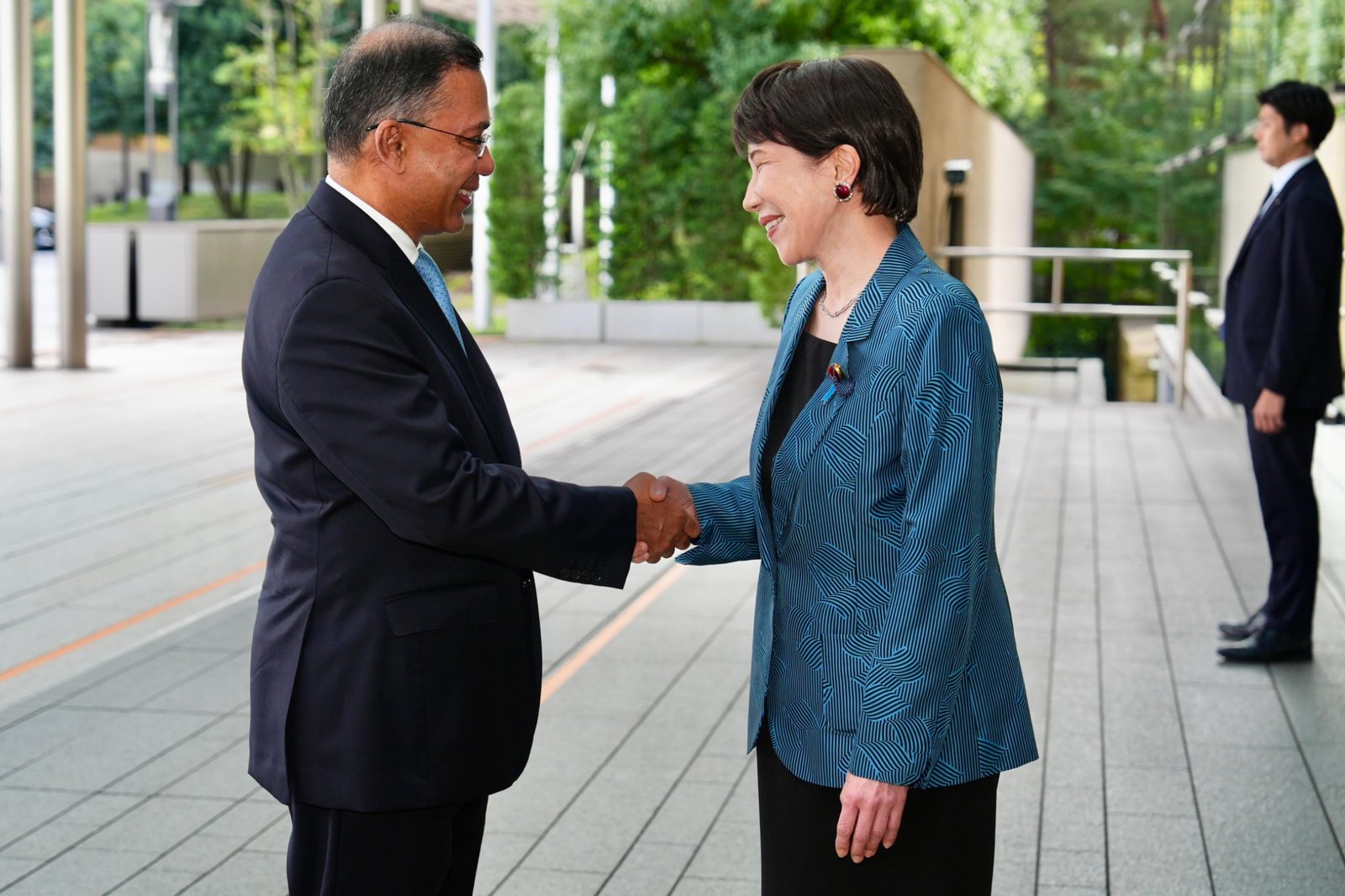
That may be changing. Tarique Rahman’s four-day visit to Tokyo brought into sharper focus a relationship that now stretches well beyond development assistance, taking in investment, trade, employment and maritime security.
The timing is also significant. Bangladesh has just secured another three years before graduating from the least-developed-country category, giving itself more room to prepare for a difficult economic transition. Japan could be an important partner in that process.
But there is a considerable distance between what the two countries have discussed and what Bangladesh can actually deliver.
A visit that goes beyond aid
The trip, from 26 to 29 October at Prime Minister Sanae Takaichi’s invitation, was his first to Japan since taking office. It followed a BNP tradition: Ziaur Rahman went in 1978 and 1980, and Khaleda Zia in 1994 and 2005.
What is different now is the framing. Takaichi described Bangladesh as a friend sharing democracy and the rule of law and pledged support for an administration that came to power through a democratic election. For a government seeking external legitimacy, that endorsement from the world’s fourth-largest economy carries weight.
From bridges to the investment climate
The foundation is older than any summit. Japan’s own evaluation calls it Bangladesh’s largest bilateral development partner, and former ambassador Ashraf Ud Doula lists the Jamuna Bridge, Dhaka Metro Rail, the airport’s third terminal and the Matarbari Integrated Development Initiative among its legacy. Yet the loans pledged this time show a change of purpose.
Two yen-loan projects worth about $295.5 million were announced: 15.88 billion yen for an Investment Climate Improvement Project and 30.68 billion yen for the second phase of the Upazila Governance and Development Project. Neither builds a bridge. One aims to repair the conditions under which private capital arrives, which is a candid admission of where the bottleneck lies.
Japan’s ambassador, Saida Shinichi, made the same point three weeks earlier, urging Dhaka to cut red tape and build upstream industries, and warning that sustained investment depends on a transparent, predictable environment.
A trillion-yen investment projection
The headline number is the private-investment projection. Japan announced plans to scale private investment to nearly one trillion yen, about $6.34 billion, over five years, expected to generate 200,000 jobs, according to the joint statement.
The Economic Relations Division reports that Japan’s cumulative foreign direct investment in Bangladesh from 2020 to 30 September 2025 was $469.6 million. The projection is therefore more than ten times what has actually arrived in the past five years, and it is a projection rather than a contract.
Takaichi herself stressed her expectation that Rahman would facilitate an environment conducive to Japanese business, and Rahman replied that his government would work toward this transparently.
Tarique also proposed a Bangladesh-Japan Tech Park to link Japanese firms and universities with Bangladesh’s young workforce. The sectors named, energy, infrastructure and ICT, are where Japan holds comparative advantage, and where Bangladeshi regulatory delay is costliest.
The Economic Partnership Agreement and trade
Trade is where the stakes are most immediate. Bangladesh and Japan signed an Economic Partnership Agreement on 6 February 2026, Bangladesh’s first with any country and, per the then commerce adviser, the first EPA Japan has signed with any least-developed country.
Under it, 7,379 Bangladeshi products get duty-free access. The deal matters because graduation would otherwise expose exports to Japan’s ordinary tariffs, which BGMEA says run from 8 to 15 percent for knitwear and from 10 to above 15 percent for woven garments. Without an agreement, experts warned of tariffs as high as 18 percent.
The EPA also moves garment rules of origin from a double-stage to a single-stage transformation requirement, which suits Bangladeshi manufacturers who import fabric.
The base is thin, however. In FY2024–25 Bangladesh imported $1.8745 billion from Japan and exported $1.4115 billion, leaving a deficit BGMEA puts at about $456 million. Despite Japan’s scale, BGMEA notes that it accounts for only about 3 percent of Bangladesh’s garment exports, and the association aims to lift annual garment shipments there to $3 billion.
One caution is that the agreement is not yet operational. A trade-press report says parliamentary ratification and implementation remain pending, and the two leaders agreed only to work toward its early entry into force. Takaichi also welcomed discussions on Bangladesh’s request to accede to RCEP, a longer-term prospect.
Labour: the gap between talk and deal
Labour is the angle Dhaka most wanted and least secured. Japan’s demographics drive demand: Tokyo has set a target of 820,000 foreign workers across 16 sectors under the Specified Skilled Worker category by March 2029. Bangladesh became the ninth country to sign a Memorandum of Cooperation on these workers in 2019, but actual flows have disappointed. The 2019 law aimed at 345,000 workers over five years, yet intake hovered around 3,000 a month even before Covid.
In May 2025, during Muhammad Yunus’s visit, a deal targeted 100,000 Bangladeshi workers over five years. The Bangladeshi ministry, though, says it plans to send 100,000 annually, and some television channels reported exactly that as a Tokyo commitment. On the visit’s last day, Japan’s foreign ministry rejected the reports.
Diplomatic sources said Tokyo had made no blanket numerical commitment. The episode matters because it shows how easily expectation outruns agreement. The real constraints sit in Bangladesh: technical training, Japanese-language proficiency and familiarity with workplace practices remain the preconditions.
Security and the Bay of Bengal
The strategic layer is where the relationship has changed most quietly. The two governments elevated ties to a strategic partnership in 2023, and this summit upgraded the Bay of Bengal Industrial Growth Belt to “BIG-B for Shared Prosperity”, resting on connectivity, resilience, public-private cooperation and peace and stability.
The physical anchor is the Matarbari-Maheshkhali area, with Dhaka’s third terminal and metro work alongside. The security component is concrete. Japan handed five patrol boats to the Bangladesh Navy in July 2026, and Takaichi announced a patrol vessel for the Coast Guard under security-contributing ODA, a grant of up to 2.12 billion yen.
The joint statement also welcomed an agreement on the transfer of defence equipment and technology. Japan is candid about motive: its foreign ministry’s own account of the programme says it aims to create a security environment desirable for Japan. Takaichi called Bangladesh an important partner in realising a Free and Open Indo-Pacific.
Dhaka is managing that framing carefully. After the visit, Foreign Ministry official Humaiun Kobir said Bangladesh did not go to Tokyo to discuss the Bay of Bengal, since it does not belong to Bangladesh alone, and that no third country was discussed. Yet the joint statement aims to make the Bay of Bengal region, with Bangladesh as its hub, one of shared prosperity.
Both positions can be true: the language is regional and economic, the hardware is maritime. Tokyo, for its part, expressed support for Bangladesh’s ability to make its own decisions amid global instability.
Japan was also preceded on Tarique’s itinerary by Malaysia, China and the United States, which fits a multi-alignment pattern rather than a tilt. The humanitarian and multilateral threads reinforce that pattern: Tarique thanked Japan for backing Foreign Minister Khalilur Rahman’s election as UN General Assembly president and for its Rohingya support, and the leaders reaffirmed the need for voluntary, safe, dignified and sustainable Rohingya return.
What to watch next
Japan’s significance, then, is real but conditional. It rests on three numbers that remain promises: one trillion yen of investment, duty-free access for 7,379 products under a treaty not yet in force, and a labour market whose size Tokyo has declined to guarantee.
The measure of this visit will be taken in the next 18 months: whether the EPA is ratified and used, whether Japanese capital shows up as factories rather than pledges, and whether Dhaka sets the terms on maritime data and command before the next boat arrives.
Jannatul Naym Pieal is a Bangladesh-based writer, researcher and journalist with over a decade of experience in professional journalism. He is also the author of 10 published books and a researcher focusing on Bangladesh’s media industry and its intersections with broader social and academic fields.