
An Unlikely Discovery on the Kachi Plain
In 1974, a French archaeological team led by Jean-François Jarrige and Catherine Jarrige began excavating a site at the foot of the Bolan Pass in Balochistan, Pakistan. They could scarcely have known they were uncovering one of the most important prehistoric sites in South Asia. The Mehrgarh archaeological site, on the Kachi Plain beside the Bolan River, preserves a long record of human settlement from around 7000 BCE to about 2600 BCE: more than four thousand years of transition from early farming villages towards the threshold of urban life.
Before Mehrgarh, many scholars assumed that farming had reached South Asia from West Asia as a ready-made package, and that the Indus Valley Civilisation appeared fairly suddenly. Mehrgarh pointed instead to a long, gradual and largely local development, and it pushed back the known history of settled life in the region by several millennia.
Why the Mehrgarh Archaeological Site Sits Where It Does
The location was no accident. The Bolan Pass is a natural corridor linking the Iranian Plateau and Central Asia with the alluvial plains of the Indus. Anyone moving goods, animals or ideas between those worlds had good reason to pass this way. The Kachi Plain offered fertile soil, seasonal river water and grazing land: an ideal setting for early farmers and herders.
Four Millennia of Neolithic and Chalcolithic Life
Excavators divided the site into successive periods. The dates below follow the conventional chronology; they vary slightly between publications, and some recent radiocarbon work on human teeth has argued for a later start to Period I.
Period I (c. 7000–5500 BCE): the aceramic Neolithic
The earliest inhabitants lived in rectangular mud-brick houses divided into small compartments, probably used for storage. They cultivated domesticated wheat (einkorn and emmer) and barley, and kept sheep, goats and cattle. They did not yet make pottery, hence the term “aceramic”. They also used baskets sealed with bitumen, and buried their dead with care, often with ornaments of shell, turquoise and lapis lazuli. Some of these materials came from hundreds of kilometres away, which points to long-distance exchange even at this early stage.
Period II (c. 5500–4800 BCE): pottery arrives
Ceramic vessels appear, along with more advanced craft production. Granaries become larger and more systematic, indicating surplus storage and a more settled agricultural economy. Some scholars place the first pottery nearer 6000 BCE.
Period III onward (c. 4800–3500 BCE and later): the Chalcolithic
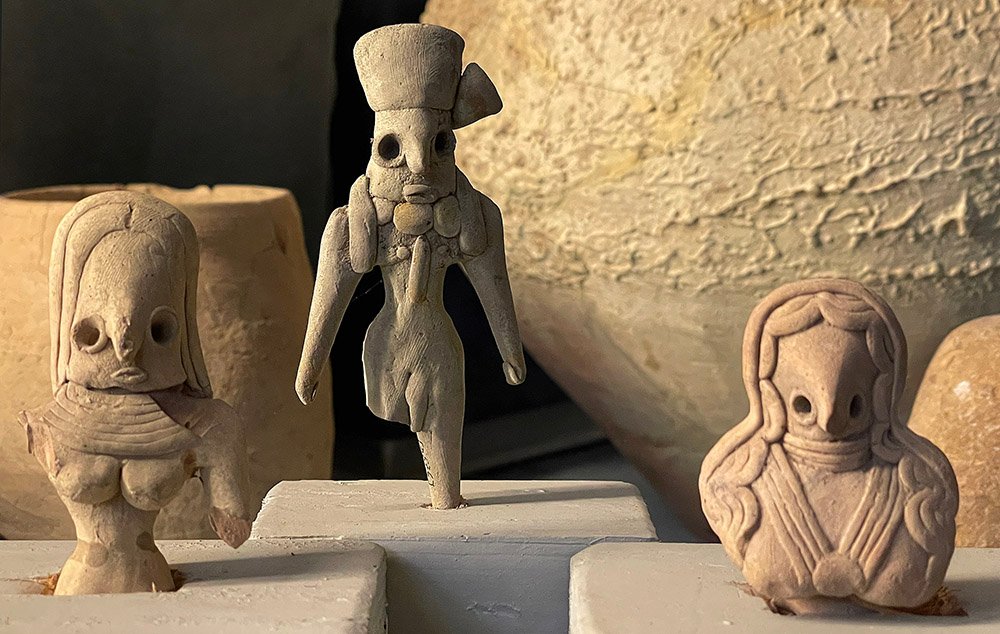
Metalworking develops considerably, although small copper objects are known from much earlier levels. Copper working is well documented, and craftspeople were producing a wide range of goods: beads, terracotta female figurines and finely made painted pottery. A small wheel-shaped copper amulet from the site, around 6,000 years old, is the earliest known object made by lost-wax casting. Pottery was increasingly produced on the wheel, and there is evidence of specialised workshops.
By about 2600 BCE, the old settlement had been largely abandoned. Its population seems to have shifted to the nearby site of Nausharo, which in turn connects directly with the Mature Harappan phase. In other words, the story of Mehrgarh flows straight into the story of the Indus cities.
Remarkable Finds at Mehrgarh
Mehrgarh has produced several discoveries that continue to surprise researchers.
- Early dentistry. A 2006 study in Nature described eleven drilled molar crowns from nine adults, dating to roughly 7,500–9,000 years ago. The holes were made with flint-tipped drills, probably operated with a bow. Some teeth show signs of wear after drilling, suggesting that at least some patients survived the treatment. It is among the oldest known evidence of dentistry anywhere in the world.
- Cotton. Cotton fibres preserved on copper beads found beside a burial are among the earliest known evidence of cotton use in the Old World. The Indus region would later become famous for its cotton textiles.
- Trade goods. Lapis lazuli from Afghanistan, together with turquoise and shell from distant sources, shows how well connected these early communities were.
- Burial practice. Graves contained ornaments and sometimes animal sacrifices, giving a rare window into early beliefs about death and status.
From Village to Indus Valley Civilisation
The Indus Valley Civilisation, also called the Harappan Civilisation, reached its mature phase between about 2600 and 1900 BCE. It was one of the three great early civilisations of the Old World, alongside Mesopotamia and Egypt. Estimates of its extent range from roughly 650,000 to 1.3 million square kilometres, and well over a thousand settlements are known. Its hallmarks included:
- Planned cities with grid-like streets, standardised baked bricks and sophisticated drainage systems.
- Mohenjo-daro, whose population is often estimated at 30,000–40,000 (figures vary), famous for its Great Bath and covered drains.
- Harappa, in Punjab, the type site that gave the civilisation its name, with an estimated population in the tens of thousands.
- Standardised weights and measures, and carved stamp seals, indicating organised trade and administration.
- Long-distance commerce with Mesopotamia, where Indus-style seals and beads have been found, and where texts refer to a land called Meluhha, widely thought to be the Indus region.
- An undeciphered script of roughly 400 distinct signs, which remains one of archaeology’s great unsolved puzzles.
Many of these features have deep roots in the cultural traditions first visible at places like Mehrgarh: mud-brick architecture, grain storage, craft specialisation, ornament-making and trade networks reaching towards Iran and Central Asia. The continuity between Mehrgarh, Nausharo and the Mature Harappan phase is one of the best arguments that the Indus civilisation largely grew from local foundations, though scholars still debate how far West Asian influence shaped the earliest farming phase.
Pakistan as Custodian of the Indus Heritage
Many of the civilisation’s most important and best-known sites lie within the borders of modern Pakistan: Mehrgarh, Mohenjo-daro, Harappa, Kot Diji, Nausharo, Ganweriwala and others. Mohenjo-daro was inscribed as a UNESCO World Heritage Site in 1980. Pakistan is therefore the principal guardian of some of humanity’s oldest urban and pre-urban heritage, and the Indus River itself, the lifeline of this civilisation, still flows through the country from north to south and remains the backbone of its agriculture.
This stewardship comes with real challenges. Mohenjo-daro suffers from salt damage and rising groundwater, and the record rains and catastrophic floods of 2022 damaged its protective covering and threatened other heritage sites. Mehrgarh itself has faced erosion, limited funding and security difficulties in the surrounding region. Protecting these sites has required cooperation among Pakistani authorities, UNESCO and international teams, and is among the country’s most significant cultural responsibilities.
The civilisation did not stop at today’s border. Major Indus sites also lie in western India, including Dholavira and Lothal in Gujarat, Kalibangan in Rajasthan and Rakhigarhi in Haryana, and a few sites extend into Afghanistan. The Indus Valley Civilisation is thus a shared heritage of the subcontinent, with Pakistan holding its core river-valley heartland and many of its most famous cities.
Why Mehrgarh Matters
Mehrgarh reminds us that civilisations do not appear from nowhere. Over roughly 4,000 years in what is now Pakistan, farmers on the Kachi Plain grew wheat and barley, tended herds, drilled teeth, traded lapis and turquoise, worked cotton and cast copper. Those accumulated skills and connections helped lay the foundations for the cities of the Indus. Today the heritage of the Indus Valley Civilisation lies largely in Pakistan, whose soil holds Mehrgarh, Harappa and Mohenjo-daro, and its story is also part of the shared history of the entire subcontinent and, ultimately, of humanity.