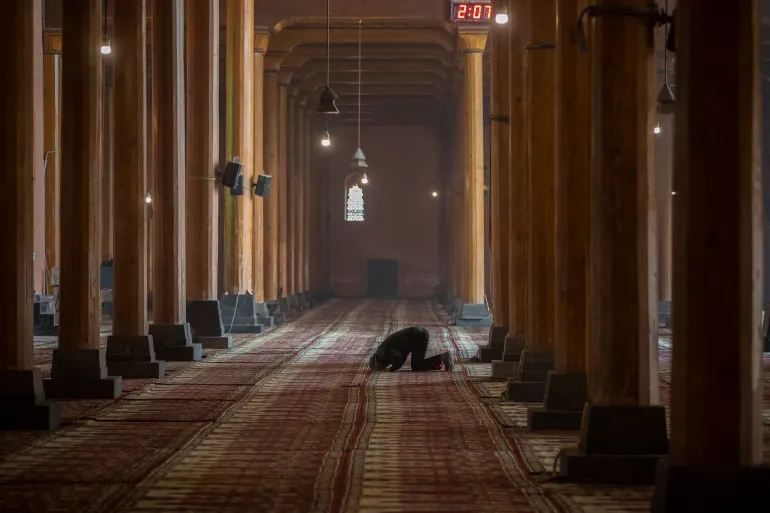
For many Kashmiri Muslims, Friday is the one hour of the week that still belongs to them. The mosque fills, the imam stands, and a community that has had little say over its own affairs hears its fears and its faith spoken aloud by someone it trusts. When the Jammu and Kashmir Waqf Board floated a plan to coordinate what is said from its pulpits, it did not read as an administrative tidy-up. It read as an attempt to reach into the last room that was still theirs.
The plan has been disowned, at least in words. The anxiety it exposed has not gone away.
What was proposed
The Waqf Board is chaired by Darakhshan Andrabi, a senior BJP leader. According to reports, it proposed a core committee of muftis, imams and khateebs to identify and finalise common topics for Friday sermons at mosques, shrines and other institutions it administers. The Board said the goal was religious awareness, moral values, social harmony and unity through better coordination.
To many Kashmiris, the word ‘coordination’ carried a different meaning. They heard a single pre-approved sermon, written by a body led by a ruling-party figure and delivered from every pulpit at once. That is the critics’ characterisation, and the Board rejects it. But the fear it expresses is old: that the religion will be allowed to continue so long as it stays quiet.
How the community heard it
Ask in Srinagar why this struck such a nerve and the answers are rarely about theology. They are about proportion. This is a Muslim-majority region where, since 2019, the political space has narrowed to the level of suffocation: autonomy revoked, statehood downgraded, protest curtailed, leaders detained, newspapers squeezed. The mosque and the shrine remained.
A coordinated khutba, in that setting, feels less like guidance and more like the final step in a sequence. The worry is not that sermons will suddenly praise the government. It is that preachers will learn, without anyone telling them, which subjects invite trouble, and will quietly stop raising them. Self-censorship is cheaper than enforcement, and it leaves no order to point to.
The backlash
The opposition was unusually broad. Chief Minister Omar Abdullah, posting on X, called it an unacceptable attempt by the BJP to interfere in the religious affairs of Muslims that would not be accepted under any circumstances. He told the Board’s chairperson to halt what he called a misplaced attempt to please her masters.
Mirwaiz Umar Farooq, who leads the Mutahida Majlis-e-Ulema (MMU), said the MMU strongly rejects any attempt to prescribe uniform Friday sermons, and that the Board must confine itself to administrative responsibilities. PDP president Mehbooba Mufti also objected. The MMU’s position was that sermon content belongs to religious scholars and imams.
That the elected Chief Minister, the region’s most prominent cleric and the main opposition party agreed on anything is itself telling. Many Kashmiris read the unity as proof that the objection was not partisan. It came from a shared sense that some lines should not be crossed.
The walk-back
On Tuesday, 13 October, Andrabi changed course. She told reporters in Srinagar, ‘There is no order. There is no order anywhere,’ and said neither she nor any Board official could decide sermon topics. She said the Khutba Rasool, the part of the sermon drawn from the Prophet’s own sermons, would not change, and that imams, khateebs and scholars were free to choose their subjects. She also asked where the BJP had interfered in religious affairs, and accused the Chief Minister of politicising the issue to mask governance failures.
Many Kashmiris welcomed the retreat but did not trust it. Ishtiyaq Mohi-ud-Din, an executive magistrate with the Board, reportedly told clerics at a virtual meeting that the directive had been issued about a month earlier, which sits awkwardly beside the claim that no order exists. The Board has not said the committee is cancelled. It has said that independent scholars will decide what to cover, and has not made clear how those scholars will be chosen. The Wire noted that until such questions are answered transparently, the proposal will remain contentious. For a community that has learned to read official language closely, a denial without a written guarantee is not reassurance.
Why the pulpit carries so much weight
To understand the intensity, it helps to know what the pulpit has meant. The Mirwaiz of Kashmir is an inherited office that has long joined religious and political roles. Mirwaiz Umar Farooq is its 14th holder.
He was placed under house arrest on 4 August 2019 and was barred from delivering sermons and leading Friday prayers for 212 consecutive Fridays, by his own count, until his release in September 2023. For more than four years, the Jamia Masjid’s pulpit stood silent on the day it matters most. Kashmiris remember each of those Fridays. A plan to ‘coordinate’ sermons lands on that memory.
There is a wider precedent too. When the Waqf Board in BJP-ruled Chhattisgarh asked mosque caretakers in November 2024 to get Friday sermons vetted in advance, it caused a similar controversy. Kashmiri critics see a template, not a coincidence.
The fight over the right to exist
Kashmiri Muslims opposing this idea are not claiming that the state intends to forbid prayer. They are claiming that existing as a people means more than being allowed to pray. It means being able to name what has happened to you, teach it to your children, and speak about it in the places you gather.
The pulpit is one of those places. So are the schools, the newspapers and the libraries. When each is brought under closer control, the space in which a community can understand itself shrinks, even if every mosque stays open. In that sense, they argue, the sermon plan was about whether Kashmiri Muslims remain authors of their own story or become subjects of someone else’s.
That is why many treated a single proposed committee as something larger. It was not the plan alone, but where it appeared on the map of everything else.
The books, and what else has been taken
The sermon row did not come out of nowhere. For many Kashmiris its clearest companion is the ban on books.
On 5 August 2025, the Home Department, which answers to Lieutenant Governor Manoj Sinha, banned 25 books for allegedly propagating ‘false narratives and secessionism’. The list was not obscure. It included A.G. Noorani’s The Kashmir Dispute, Victoria Schofield’s Kashmir in Conflict, Arundhati Roy’s Azadi, Sumantra Bose’s Contested Lands, and Anuradha Bhasin’s A Dismantled State.
The order argued that such literature, often ‘disguised as historical or political commentary’, plays a critical role in ‘misguiding’ youth. It cited investigations and intelligence inputs that have not been published in full. Police raided booksellers and publishers across the Valley two days later, checking inventories, registers and even laptops. One bookseller said banned titles were being pulled from shelves and unsold stock returned to publishers.
Writers and scholars said the books were history, not propaganda. Berkeley scholar Angana Chatterji said the order sought to ‘criminalise scholarship and render it seditious’, and Sumantra Bose said he had spent his career seeking pathways to peace. Omar Abdullah distanced himself, saying the ban was imposed by the Lieutenant Governor through the Home Department, which does not answer to him, and that he had never banned books and never would. To Kashmiri Muslims, that detail confirms that decisions about what they may read are taken outside the government they elect.
From the bookshop to the library
In July 2026, Middle East Eye reported that authorities had ordered a multi-level audit of public libraries and educational institutions to purge books and digital material. It suggests the ban has moved from the bookshop to the school and public library, where most people actually read.
Missing records and archives
Then there are the records. In 2022, AFP reported that hundreds of reports chronicling decades of violence had disappeared from local newspaper archives, many covering the mass protests of 2008, 2010 and 2016. A Kashmir Times editor said it seemed ‘as if nothing had happened in Kashmir before 2019’. One outlet’s administrator called it a technical issue, and no single case proves a coordinated order. The files of the former State Human Rights Commission have been locked in a room since 2019, and the administration told an RTI applicant it holds no information about them. A University of Kashmir historian connects these to the removal of Martyrs’ Day from the list of official holidays as parts of one trend, while acknowledging it is hard to tell negligence from design.
Kashmiri Muslims who see a pattern say this is what it looks like when a people is made to doubt its own memory: the books gone, the archives patchy, the pulpit next. Officials say each step has a security rationale, and the archive evidence remains disputed. Both can be true while the facts are still being established. What Kashmiris are asking, plainly, is that the places where they record and recite their own history stay in their hands.