
Every great human achievement begins as an act of defiance against the word ‘impossible’. For thousands of years, the sky belonged to birds and to myth. Then, in ninth-century Córdoba, a scholar looked up and decided that the heavens could be reached by reason, craftsmanship and courage. His name was Abu al-Qasim Abbas ibn Firnas, and the world has been slow to give him his due.
He deserves to be remembered as one of history’s earliest recorded pioneers of flight, the first person known to have designed a wing-like apparatus and trusted his own body to it. He was also a polymath whose gifts spanned poetry, astronomy, medicine, optics and engineering. His story is not only about one man. It is about what a confident, curious civilisation can produce.
A Mind Without Borders
Ibn Firnas was born around 810 in Ronda, in Al-Andalus, and rose to prominence at the court of the Umayyad emirs of Córdoba, serving under Abd al-Rahman II and Muhammad I. At that time, Córdoba was a beacon. While much of Europe struggled through its early medieval centuries, the Andalusian capital boasted paved streets, public lighting, libraries, hospitals and a thriving culture of learning.
Within that world, Ibn Firnas became a figure of legendary versatility. The chroniclers describe a philosopher-engineer: a poet who mastered Arabic prosody, a musician, an astronomer, a physician and an inventor. He is credited with bringing the metrical theories of Al-Khalil ibn Ahmad to Iberia, which elevated Arabic poetry in the western Islamic world. He is also credited with working out methods to produce clear glass from sand and with grinding lenses used as reading stones, innovations that anticipate the optical revolution to come.
The sources also attribute to him a water clock, an armillary sphere for modelling the heavens, and a remarkable chamber in his home that recreated the night sky, with stars, clouds and even artificial thunder and lightning. Here was a man who did not merely observe nature but sought to reproduce it, test it and master it. That is the essence of the scientific method, practised more than a thousand years ago.
A Civilisation That Dared
Ibn Firnas did not emerge from nowhere. He was nourished by the intellectual energy of the Islamic Golden Age, an era that translated, preserved and extended the knowledge of the Greeks, Persians and Indians, and then went further. Paper mills multiplied the reach of books. Scholars travelled across continents. Patrons funded experiments. Curiosity was treated as a virtue, not a threat.
This context is not a footnote to his achievement. It is the reason his achievement was possible. A society that honours inquiry will always produce someone willing to ask the boldest question. In Córdoba, that question was simple and breathtaking: why should humans not fly?
The Leap from the Minaret
The traditional accounts of his flights come down to us through the Andalusian historical tradition, most famously through the historian Ahmed al-Maqqari, who relied on earlier chroniclers including Ibn Hayyan. They describe two attempts.
The first, around 852, took place at the Great Mosque of Córdoba. Ibn Firnas, so the tradition holds, climbed a minaret wearing a great cloak stretched over a wooden frame and leapt. The cloak filled with air and slowed his descent, and he landed with only minor injuries. It was a parachute-like descent, centuries before the word existed. A lesser man might have taken the narrow escape as a warning. Ibn Firnas took it as proof of concept.
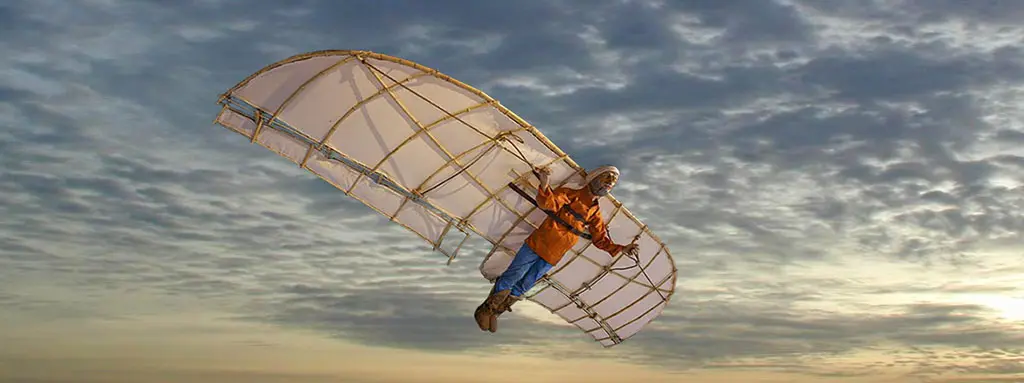
The second attempt, around 875, is the one that secures his place in history. By now he was in his sixties, an age when most men retreat into comfort and reputation. Instead, he refined his design. He built a pair of wings of silk stretched over a lightweight frame and covered with eagle feathers. He climbed a hill near the royal estate of Rusafa, before a gathering of spectators, and launched himself into the air.
The accounts say he stayed aloft for a considerable time, gliding, a man held up by an invention of his own making. When he came down, the landing was hard, and he was injured, reportedly in the back. What followed is perhaps the most revealing moment of the entire story. Ibn Firnas himself analysed the failure and concluded that he had forgotten to fit a tail. He had understood by instinct what aeronautical engineers would later formalise: a flying body needs stability as well as lift.
Consider what that reveals. He did not blame fate. He did not abandon his idea. He studied his own failure and identified a design flaw. That is not the behaviour of a dreamer. It is the discipline of an engineer.
Earlier Than the Rest
His priority matters. The best-known European parallel, Eilmer of Malmesbury, is dated to around 1010, and his story was recorded more than a century after that. Ibn Firnas preceded him by roughly a hundred and fifty years. Long before the glider experiments of the modern West, an Andalusian scholar had already built wings, taken to the air, and diagnosed what went wrong.
The historian Lynn White Jr., in his well-known study of early flight attempts, treated the Andalusian tradition seriously and placed Ibn Firnas at the head of the line of medieval experimenters. That recognition from a leading historian of technology reflects how the story has been regarded by serious scholarship: as the first chapter in the long human effort to fly.
What Was Lost, and What That Means
A critic will point out that no treatise on flight by Ibn Firnas survives. That is true, and it should be understood for what it is: a wound inflicted by history, not a verdict on his work.
The libraries of the Islamic world suffered catastrophic losses. Córdoba itself was ravaged in the civil strife that tore apart the caliphate in the early eleventh century, and its great collections were scattered and destroyed. Later centuries saw the brutal Reconquista dismantle much of Andalusia’s learned heritage. And Baghdad, the intellectual capital of the age, was sacked by the Mongols in 1258, when the House of Wisdom and countless libraries were destroyed, and, in the famous image repeated by chroniclers, the Tigris was said to run dark with ink.
Think about what that means. We do not possess a fraction of what the scholars of the Islamic Golden Age wrote. The absence of a surviving manuscript is not evidence that no research took place. It is evidence of a civilisation’s memory being burned. When we judge Ibn Firnas, we are looking through a keyhole at a vanished library. The wonder is not that so little survives, but that his name, his flights and his inventions were remembered at all across the centuries.
That memory was carried by Andalusian historians who thought his deeds worth recording, and who preserved the story through exile, war and upheaval. A tradition that survives that much destruction was valued by those who knew it best.
The Spirit Behind Modern Aviation
The history of invention is not only a ledger of citations. It is also a history of ideas, of the slow accumulation of human belief that something can be done. Every generation that dreamed of flight, and every experimenter who tried, belongs to a single story whose opening scene was written in the Andalusian hills. Ibn Firnas proved, at least in the memory of civilisation, that the attempt could be made by a human being using nothing but intelligence and nerve. He planted the idea in the human imagination as a task for engineers rather than a fantasy for poets.
That is a legacy of the highest order. The first person to attempt a thing does not need to supply the blueprint for every successor. He supplies the proof that the attempt is worth making.
Honoured Across the World
Recognition, though late, has come. Ibn Firnas is known as the father of aviation. A crater on the Moon bears his name. Baghdad’s airport once honoured him, and a bridge in Córdoba stands in his memory. Statues and memorials in the Muslim world celebrate the man who looked at the sky and refused to see a ceiling. Each of these tributes says the same thing: a civilisation remembers those who expanded its sense of the possible.
He died around 887, having lived long enough to attempt what no one had attempted. He left no air force, no factory and no manual. He left something more durable: an example of courage in the service of knowledge.
Lessons for Our Age
The story of Ibn Firnas speaks directly to those who build institutions and shape policy.
- Invest in breadth. His genius flourished across disciplines. Societies that prize narrow specialisation at the expense of synthesis risk missing the connections where breakthroughs live.
- Fund the attempt. The Umayyad court gave scholars standing, resources and freedom. Nations that want their own golden age must reward ambition before it is proven, not after.
- Treat failure as knowledge. Ibn Firnas is remembered for diagnosing his fall, not for suffering it. Cultures that punish failure will never produce a first flight.
- Protect memory. The destruction of Córdoba’s and Baghdad’s libraries is a permanent warning. Knowledge that is not preserved can vanish in a single generation. Guarding archives, manuscripts and scholarly traditions is among the highest duties of any civilisation.
Picture the scene: a hillside outside Córdoba, a crowd gathered in silence, and an elderly scholar in wings of silk and feathers, standing at the edge of everything that was known. Then he leaps.
That image endures because it captures something essential about human progress. The future is never reached by those who wait for certainty. It is reached by the few who risk the fall for the chance of flight.
Abbas ibn Firnas was one of them, and he was among the very first. The sky he reached for is now crossed by millions every day. Every one of those journeys carries, however faintly, the echo of a ninth-century dream that began in Andalusia.