The eighth Moscow Format meeting on Afghanistan was meant to showcase regional coordination. Instead it exposed how divided Afghanistan’s neighbours are on the Taliban and on terrorism. Russian Foreign Minister Sergey Lavrov’s opening remarks drew as much attention for what he left out as for what he said. The summit ended without a joint statement, and the dispute between Kabul and Islamabad overshadowed it.
What happened at the eighth Moscow Format meeting
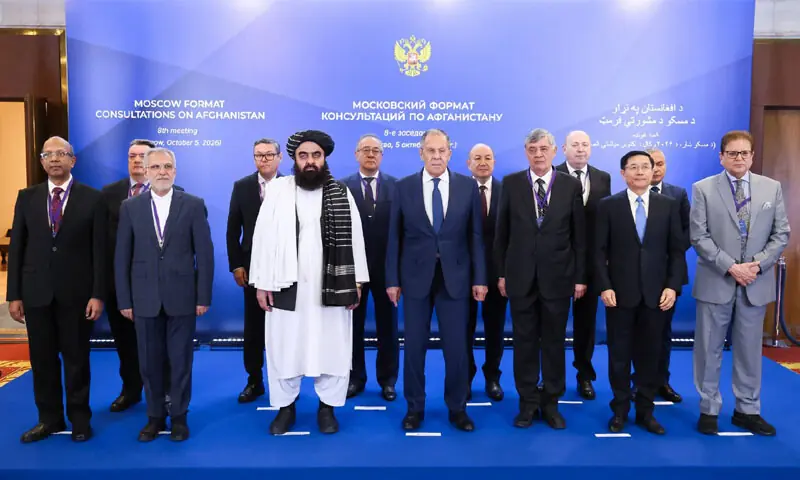
The meeting took place in Moscow on 5 October 2026. Representatives from Afghanistan, China, India, Iran, Kazakhstan, Kyrgyzstan, Pakistan, Russia, Tajikistan and Uzbekistan attended, with Belarus and Egypt invited as guests. Taliban Foreign Minister Amir Khan Muttaqi led the Afghan delegation.
Lavrov’s opening speech was warm towards Kabul. He praised the Taliban’s record since the 2021 withdrawal of US and NATO forces, which he framed as Afghanistan’s liberation from two decades of Western ‘occupation’, and said the Taliban-led government had brought the country’s territory under control and was governing it successfully. He also rejected any future deployment of NATO military infrastructure in Afghanistan or neighbouring countries.
According to the Russian Foreign Ministry, participants were to focus on political and economic cooperation between Afghanistan and regional countries, as well as stronger coordination against terrorism and drug trafficking.
Lavrov’s focus on ISKP, and what he didn’t address
Lavrov’s comments centred on the Taliban’s actions against Islamic State Khorasan Province (ISKP), the regional Daesh affiliate. He did not address several other contentious issues: restrictions on women and girls, the exclusion of minorities and concerns about religious indoctrination.
The omissions stand out because Russia has voiced serious concerns about extremist networks in Afghanistan before. Moscow itself has acknowledged that Afghanistan’s militant landscape extends beyond ISKP: in May, Russian Security Council Secretary Sergey Shoigu said that an estimated 18,000 to 23,000 militants from more than 20 groups were operating in Afghanistan, with Islamic State accounting for around 3,000 of them. The question for neighbouring states is not only whether the Taliban are fighting ISKP, but whether Afghan soil is being denied to every group planning cross-border attacks.
Why Russia is courting the Taliban
Moscow’s approach makes more sense against its recent diplomacy. In July 2025, Russia became the first country to recognise the Taliban administration. The Taliban took part as a formal member of the Moscow Format for the first time at the seventh meeting in October 2025. Russian officials have also tied Moscow’s counter-terrorism cooperation with Afghanistan closely to bilateral military-technical collaboration.
Russia’s strategic interests are fairly clear:
- Keeping militancy out of Central Asia, which Moscow regards as its security backyard.
- Limiting Western influence in the region, a theme that ran through Lavrov’s NATO remarks.
- Securing a stronger political position in a changing regional order.
From the Kremlin’s viewpoint, a working relationship with Kabul is a practical necessity. The risk, critics argue, is that counter-terrorism becomes a geopolitical bargaining chip. If the Taliban stay aligned with Moscow, concerns about terrorism and governance may fade from Russian messaging. If Kabul drifts towards Washington, the same issues could return to the top of Russia’s agenda. That would treat terrorism as an instrument of foreign policy rather than a shared regional threat.
Pakistan’s Counter-Narrative
Pakistan used the Moscow platform to press a very different message. Special Representative for Afghanistan Mohammad Sadiq told the meeting that the roots of terrorism emanating from Afghanistan lie in a nexus between the Taliban regime and terrorist groups that operate with impunity on Afghan soil. He also asked whether the Taliban’s policies have helped ordinary Afghans and addressed the legitimate concerns of the immediate neighbours.
Islamabad has backed this up with casualty figures. According to Pakistani security data cited by officials, terrorism from Afghan soil has caused 1,327 Pakistani fatalities and 2,484 injuries in 2026, while the Pakistani military said in late July that security forces had killed 2,084 terrorists nationwide this year. Pakistani authorities say 260 Afghan nationals were among those killed while allegedly involved in terrorist activity inside Pakistan, and they say a large proportion of militants infiltrating from Afghanistan are Afghan nationals.
The Backdrop
The Moscow meeting took place during a sharp deterioration in Pakistan–Afghanistan relations, and the timing explains much of the friction in the room.
The wider conflict has been escalating since February 2026. The 2026 clashes began with Pakistani airstrikes on alleged TTP and ISKP camps in eastern Afghanistan and escalated within a week into what Pakistan’s defence minister, Khawaja Asif, called ‘open war’. An earlier Qatari-mediated ceasefire ended the intense October 2025 fighting, but several rounds of talks in Turkey in November failed to produce a lasting agreement.
The latest flare-up came just days before the summit. Pakistan carried out air strikes in Helmand and Kunar provinces on 1 October, and the Taliban claimed civilian killings. Pakistan’s Information Ministry said the strikes relied on credible intelligence and targeted the TTP and the Balochistan Liberation Army. Pakistan’s military spokesman also claimed that the Taliban governor of Kandahar hosted a meeting between the BLA, Al Qaeda in the Indian Subcontinent and the Hafiz Gul Bahadur group. A senior Taliban official has rejected that claim, according to Afghan media, and the Taliban deny Pakistan’s wider accusations.
No joint statement: the Moscow Format’s credibility test
The summit’s most telling outcome was what it failed to produce. The meeting ended without a joint statement because the Taliban and Pakistani delegations disagreed over the text, according to Russia’s special representative for Afghanistan, Zamir Kabulov. Kabulov argued the format can continue without one, though a statement would be more proper. He stressed that it is a platform for coordinating regional cooperation, not for resolving bilateral disputes. Participants did call on both the Taliban and Pakistan to refrain from military action and offered to help find a solution.
That framing sits awkwardly with the stated purpose of the forum. The Moscow Format was established in 2017 as a consultative mechanism covering political, security and economic developments in Afghanistan. If it cannot reflect the security concerns of the countries absorbing the violence, its value as a regional security mechanism is open to question.
Why this matters for regional security
Several lessons stand out.
- Selective counter-terrorism undermines trust. Targeting one group while overlooking others leaves neighbours exposed. For Pakistan and the Central Asian states, the threat is wider than ISKP. It includes the TTP and other networks.
- Diplomacy and security cannot be fully separated. Russia’s engagement with Kabul serves its strategic goals, but neighbours see security and the political relationship as linked. Normalising ties without firm counter-terrorism benchmarks leaves their core concern unresolved.
- Human rights and governance remain unaddressed. Intensive restrictions on women and girls and the exclusion of minorities were left out of the headline messaging. Critics argue that governance failures and extremism feed one another over time.
- The Moscow Format risks becoming a legitimisation platform. Some Pakistani commentators have argued that the forum is turning into a stage for the Taliban rather than a mechanism that holds them to account. Moscow would likely say it is simply engaging with the government actually in control of Afghanistan.
The Russian perspective
Russia argues that engagement, not isolation, is the most realistic way to influence the Taliban and keep Central Asia secure. Lavrov also has a point that ISKP is a genuine and violent threat, and Taliban operations against it serve regional interests, including Russia’s. Moscow’s position is that the Moscow Format is not designed to settle disputes between members, and it has offered to help Kabul and Islamabad reach a compromise if they request it.
The disagreement is therefore about emphasis and standards. Russia sees a government delivering on a narrow set of security priorities. Pakistan sees one that tolerates the terror groups most dangerous to its own citizens.
Strategic Outlook
The eighth Moscow Format meeting showed both the promise and the limits of regional diplomacy on Afghanistan. Lavrov’s praise confirmed that Moscow has bet on engagement with the Taliban. Pakistan’s pushback and the missing joint statement showed that this approach does not satisfy every neighbour.
The central issue is simple. Regional security cannot be reduced to the threat from ISKP alone. Unless forums like the Moscow Format address all militant networks operating from Afghan territory, as well as the political environment that sustains them, their ability to deliver lasting security will stay in doubt.