For eighty years, the security of the Middle East ran through Washington. Gulf monarchies bought American arms and hosted American bases, and in return they assumed the guarantee would hold when it counted. Today that assumption is being retired. What is taking its place is a regional order built by the region’s own powers, with Pakistan, Türkiye and Saudi Arabia at its core.
The end of the guarantor
The war on Iran made the case more forcefully than any argument could. When the US-Israeli campaign began, it was not Washington’s partners who set about containing it. It was the Muslim world’s own capitals. Pakistan, Saudi Arabia, Türkiye and Egypt, the group now known as the R4, emerged in March to coordinate mediation, and Islamabad hosted its foreign ministers to prepare the ground for de-escalation. When the states most exposed to the fallout take up the work of peacemaking themselves, they are saying where they believe stability will come from.
The lesson drawn across the region is plain. A security guarantor that cannot be relied upon is a liability, because the region hosts the US bases, absorbs the retaliation, and watches the guarantor choose the timing of escalation. Opinion in many capitals has converged on the view that the United States is no longer a dependable partner, and that security has to be built from within.
The Abraham Accords: a fading bargain
The Accords were sold as a new regional logic: normalisation in exchange for security, investment and technology. They have delivered little to the Arab and Muslim signatories, while the political cost rises with every escalation. They are becoming a historical burden for the governments that signed them, going against the majority Muslim will, a bet on a patron that failed to protect the region.
The Abraham Accords have reduced the moral burden, especially given the scenario where the Makkah defence agreement has come up as an alternative geopolitical possibility. The Israeli strategy of divide and rule, in which friction between the Gulf states and Iran serves Israeli interests, seems to be failing. Gulf states and Iran’s neighbours have chosen to be adamant on peace over escalation despite having every reason to escalate, with Pakistan not ready to give up on peace efforts, Qatar and Oman playing their role in mediating and Saudi Arabia and Türkiye taking every careful step in the right direction.
An architecture without Washington
The institutional record is now substantial, and each piece builds on the last.
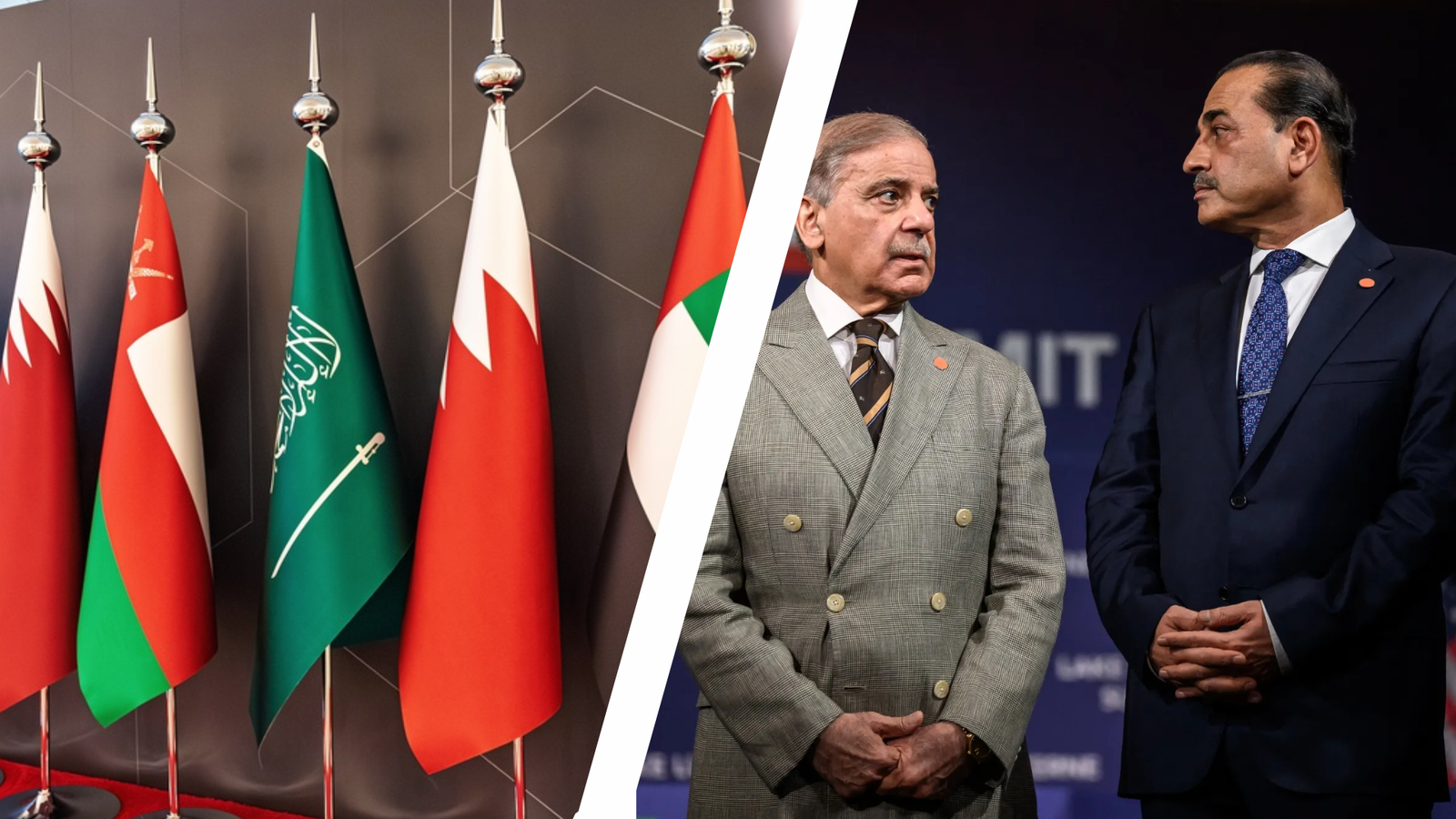
The Makkah Joint Defence Agreement. In August 2026, Saudi Arabia, Türkiye and Pakistan signed a collective defence pact. Pakistan completed its ratification this week. Türkiye has said the pact is not aimed at any country and remains open to others, including Egypt. It marked a watershed moment in history when three Muslim countries sat together at the same table with a promise to defend each other, a moment that the Muslim world had awaited for a century and a decade.
The Badr MoU. On 21 October in Doha, Pakistan, Türkiye, Qatar and Indonesia signed a multilateral framework for defence-industrial cooperation covering manufacturing, technical training, and research and development. The logic is complementary. Türkiye brings technology and systems integration, Pakistan and Indonesia bring manufacturing capacity and large domestic markets, and Qatar brings investment. Other friendly nations may join under agreed criteria. Where Makkah is a mutual-defence commitment, Badr is an industrial one, and together they mark a shift from bilateral arms purchasing to shared production.
The R4 meets the E3. On 23 October in Istanbul, Türkiye hosted the first-ever meeting of the R4 (Pakistan, Türkiye, Saudi Arabia, Egypt) with the foreign ministers of the UK, France and Germany, with Italy also taking part. This was the first time the two groups sat together, and it happened at Ankara’s initiative. The agenda covered the US/Israel-Iran conflict, a negotiated two-state solution for Israelis and Palestinians, the Houthi attacks on Saudi Arabia, and freedom of navigation in Hormuz and Bab el-Mandeb. Foreign Minister Fidan noted that none of the countries present approved of another military intervention or attack on Iran. European powers were coordinating with a regional bloc on the region’s future, with Washington not at the table.
The Tehran visit. On 26 October, as tensions with Israel and the US were running high, a Makkah Pact delegation arrived in Tehran. Saudi Defence Minister Prince Khalid bin Salman, Pakistan’s Field Marshal Asim Munir and Turkish intelligence chief Ibrahim Kalin met Iranian President Masoud Pezeshkian and Iran’s Supreme National Security Council secretary Mohsen Rezaei, in the presence of Foreign Minister Abbas Araghchi. Iranian officials said Pakistan had proposed the format, and it was the first joint visit by senior officials of the pact since its founding. The Saudi foreign ministry described the mission as an effort to de-escalate, encourage dialogue and support the mediation of Qatar and Pakistan. A Saudi-led delegation with Pakistan and Türkiye walking into Tehran on the eve of potential escalation says more about the new balance of influence than any communiqué.
Together these steps point to the same destination: a regional framework built with European partners but without American leadership, resting on the mediation Pakistan championed and Qatar and Oman have already pioneered.
Pakistan’s moment
Pakistan’s rise has several roots. It is a nuclear-armed state with a large and experienced military. It holds a defence pact with Riyadh and an industrial partnership with Ankara. It enjoys working relations with Beijing and credibility in Tehran, which is why Iran accepted its proposal for the joint visit. Hosting the March talks gave it a diplomatic profile it has rarely enjoyed, and the Badr framework lets it diversify its defence supply rather than depend on a single supplier.
Its reach now extends into the Indian Ocean. Much to the shock of New Delhi, Maldivian President Mohamed Muizzu’s state visit to Pakistan from 20 to 22 October was the first by a Maldivian president in eleven years. The two countries signed 20 agreements spanning defence, maritime cooperation, cybersecurity, information technology, health, education and tourism. After taking office on an ‘India Out’ platform and then securing financial lifelines from New Delhi, Muizzu also concluded a free-trade agreement with China and a preferential trade agreement with Türkiye, and his Islamabad agreements deepened the hedge. Pakistan’s involvement in defence capacity-building near vital sea lanes challenges India’s strategic depth in its own neighbourhood. In New Delhi’s framing, an Indian-UAE-Israeli-American alignment is building an ‘axis of influence’ and the Sino-Pakistani partnership is an ‘axis of resistance’, though the Maldives itself is better read as a small state exercising its sovereign right to choose its partners.
China and Russia
Beijing and Moscow are less the architects of this order than its beneficiaries. China wants a stable, multipolar Gulf that keeps energy flowing without American primacy, and a Pakistan with a wider circle of partners eases its own burden. Chinese scholars see Badr as part of a broader trend of countries turning to Global South partners to diversify their security ties. Russia gains from any dilution of the Western security monopoly and from a Gulf that hedges rather than aligns. Neither offers Washington’s kind of guarantee, which is why the new frameworks are networks of partners rather than a rival hegemon.
History’s verdict
Moments like this are recognised only in hindsight, but the signs are visible now. A defence pact among three Muslim-majority powers has been ratified by two of them, with Türkiye’s parliament now reviewing it. A four-nation defence-industrial framework is signed. The region’s leading diplomatic bloc sits down with Europe’s major powers. A delegation led by Saudi Arabia walks into Tehran with Pakistan and Türkiye beside it. Taken together, they describe a region that has decided to stop waiting for an outside guarantor and to write its own security order. Whatever one thinks of it, that is a turning point that the Muslim world awaits keenly.
Aisha Ghazi is a human rights lawyer, author, and documentary filmmaker dedicated to uncovering untold histories. Her work focuses on war and conflict, socio-psychological grounds dictating violence, refugee crisis, geopolitics and history. She is the director of iResist, a human rights platform that advocates human rights through documentary, and a Solicitor of the Supreme Court of England and Wales.