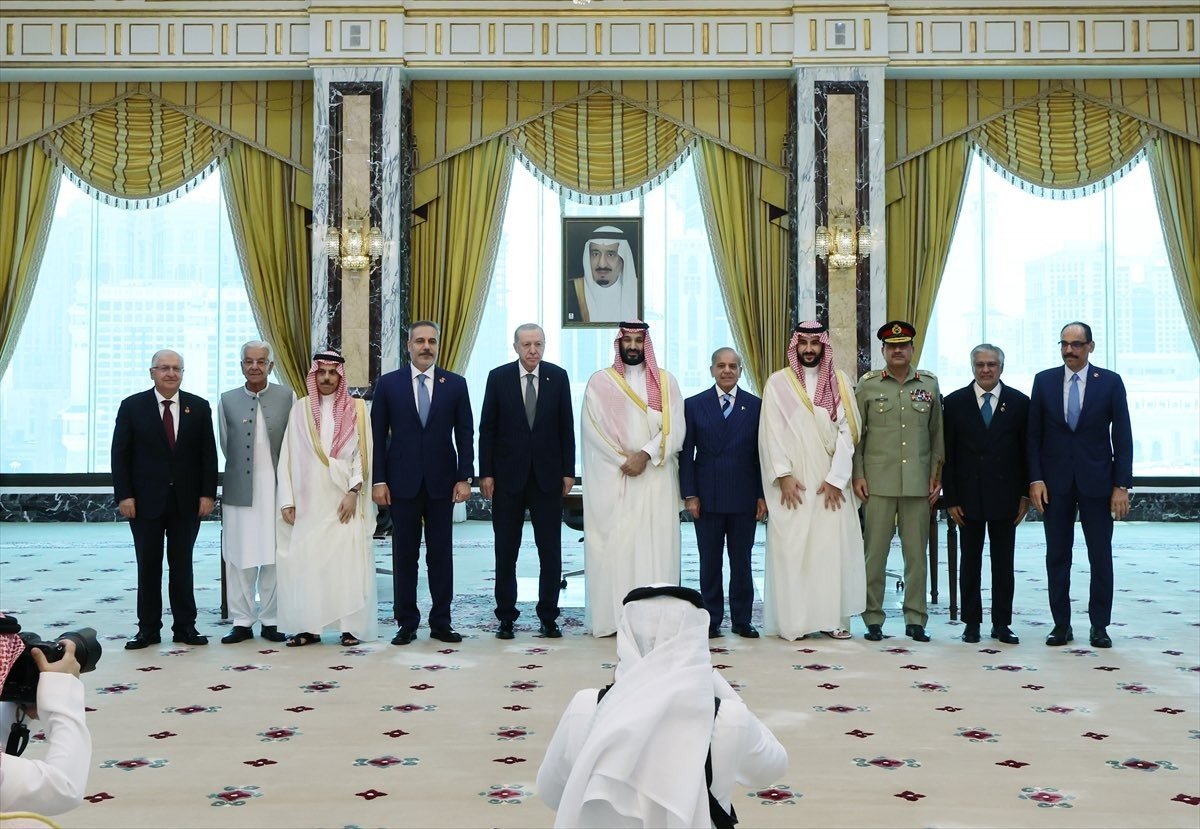
The formalisation of a trilateral defence agreement between the Kingdom of Saudi Arabia, the Republic of Türkiye and the Islamic Republic of Pakistan on 7 August 2026 marks a watershed moment in Middle Eastern and South Asian security architectures. Signed in Jeddah by Crown Prince Mohammed bin Salman, President Recep Tayyip Erdogan and Prime Minister Shehbaz Sharif, the treaty represents a profound pivot away from traditional reliance on Western security guarantees. Driven by escalating regional volatility, particularly the recent conflict involving the United States, Israel and Iran, this agreement creates a new centre of gravity in the geopolitics of the broader region. In effect, it represents the rise of a new “Islamic NATO”, bringing the three most powerful Muslim countries under a single defence structure, with the capacity for many more Islamic nations to join.
The Strategic Logic of the Triad
From an analytical perspective, the alliance fuses distinct national capabilities into a complete, cohesive deterrent.
- Saudi Arabia (The Economic and Diplomatic Anchor): Riyadh provides the capital depth and energy dominance necessary to sustain long-term strategic initiatives. Furthermore, Saudi Arabia’s diplomatic weight and central status in the Islamic world lend the pact unparalleled regional legitimacy, allowing the alliance to operate from a position of economic independence. This prevents the members of the alliance from struggling against sanctions in the event of a confrontation with a major economic power.
- Türkiye (The Industrial and NATO Bridge): Ankara brings a sophisticated defence-industrial base and crucial geographic positioning. As a NATO member with advanced indigenous military manufacturing capabilities, including autonomous systems, naval assets and aerospace technologies, Türkiye provides the alliance with a critical technological edge. Türkiye has become an unparalleled leader in the global race to develop indigenous arms. This expertise will benefit all members of the alliance, as Türkiye can provide assistance and expertise in setting up similar indigenous defence-tech factories across all three countries.
- Pakistan (The Demographic and Nuclear Shield): Islamabad contributes unmatched conventional military manpower and deep strategic depth in South Asia. Most critically, as the only nuclear-armed state in the Muslim world, Pakistan introduces a profound layer of strategic deterrence that permanently alters the calculus for any regional adversary. Any state or non-state actor attempting to cross red lines with any of the three members now faces a significantly more complex deterrence calculation, one that now includes one of the few nuclear powers in the world.
This trilateral arrangement builds upon the bilateral Strategic Mutual Defence Agreement signed between Riyadh and Islamabad in September 2025, which stipulated that an act of aggression against one would be treated as an act of aggression against both. The inclusion of Türkiye broadens the scope of this collective security framework significantly, formalising a major Islamic security bloc. The agreement is being hailed in all corners of the Muslim world, with many countries including the OIC congratulating the three countries on the signing of the “Makkah Joint Defence Agreement”.
Catalysts for an Indigenous Security Architecture
The formation of this triad is a direct consequence of shifting global power dynamics. Historically, Gulf security was underwritten by the United States. However, recent regional turmoil and the direct conflict with Iran have exposed the vulnerabilities of the American security umbrella. States in the region have increasingly concluded that external security guarantees can be conditional, reactive and insufficient to prevent direct threats to their sovereignty or economic lifelines, such as disruptions in the Strait of Hormuz.
By pooling resources and integrating their strategic postures, Riyadh, Ankara and Islamabad are actively constructing an indigenous security framework. This reduces their vulnerability to proxy conflicts and external pressure, signalling a clear desire to manage regional stability without relying on Washington or European capitals. Israel’s genocidal aggression in Gaza, and the rest of the Middle East, was also a major catalyst to the Makkah Joint Defence Agreement. In the face of increased pressure to succumb to the Abraham Accords, and an increasingly expanding Israeli attack radius, Saudi Arabia’s decision to sign this agreement is an unambiguous statement of intent. Saudi Arabia has signalled it has no desire to sign the Abraham Accords to attain regional peace, and is demonstrably willing to carve its own path with its fellow Islamic nations if the United States refuses to accommodate Saudi Arabia’s policy on Israel.
Strategic Ramifications for Regional Actors
Iran: Encirclement and Containment
In Tehran, the Mecca Agreement will be viewed with acute strategic anxiety. The formalisation of a unified security bloc effectively encircles the state. On its eastern border lies a nuclear-armed Pakistan; to its northwest sits a NATO-integrated Türkiye; and to its south and west, a heavily fortified Saudi Arabia. This architecture severely complicates Tehran’s traditional reliance on asymmetric proxy warfare. As the recent conflict exposed the vulnerabilities of Gulf states to Iranian action, this pact serves as a direct, unified containment strategy. Iran now faces a coordinated conventional and nuclear deterrent across all its major frontiers, forcing a complete re-evaluation of its regional projection capabilities and expansionist goals.
Israel: A Shift in the Balance of Power
For Israel, the pact introduces unprecedented strategic complexities. Whilst Israel has historically relied on its Qualitative Military Edge (QME) and bilateral normalisation efforts under the Abraham Accords, the emergence of an independent, highly capable trilateral alliance alters the regional calculus. Israel must now factor in the combined weight of Turkish defence manufacturing and Pakistani deterrence when evaluating regional security. As this agreement dilutes Washington’s influence over Gulf security, Israel can no longer rely on the US to unilaterally manage, predict or restrain the strategic postures of major Muslim powers, reducing their freedom of action in the broader Middle East.
India: The South Asian Security Dilemma
In New Delhi, the treaty will be analysed strictly through the lens of a shifting South Asian balance of power. The prospect of Saudi capital financing the transfer of advanced Turkish military technology to Pakistan presents a significant challenge to Indian strategic planners. As Islamabad deepens its integration with Ankara and Riyadh, India faces an elevated risk of a highly modernised, multi-domain threat on its western frontier. The potential for Pakistan to acquire state-of-the-art Turkish unmanned aerial systems, naval corvettes and electronic warfare suites, underwritten by Saudi wealth, directly threatens India’s desire to assert its regional superiority. India’s superiority in the region has already been placed in doubt after the May 2025 Indo-Pakistan War, where reports indicate seven Indian jets were shot down by Pakistan’s Air Force, with no aircraft lost on the Pakistani side. This defence pact now places them in an unprecedented strategic environment, as Pakistan emerges as a dominant diplomatic and military power in the region. This will likely accelerate India’s own defence modernisation and prompt a rapid tightening of its strategic partnerships within the Quad and with Western allies, including Israel. This is also a particular setback to India’s heightening bilateral ties with Saudi Arabia in the last decade. Indian policymakers and commentators had welcomed the increased coordination and collaboration between their state and Saudi Arabia, which was displayed through joint naval exercises and high-level state receptions for India’s PM Modi. Today, India appears to have lost such leverage.
Looking Forward
The Makkah Joint Defence Agreement is more than a reactionary measure to immediate crises. It is a calculated, long-term strategic realignment. By combining deep capital reserves, advanced defence manufacturing and nuclear deterrence, Saudi Arabia, Türkiye and Pakistan have established a formidable, independent security bloc. As the geopolitical landscape continues to fragment into multipolar realities, this trilateral alliance will likely serve as a foundational pillar for regional stability, permanently redefining how security, deterrence and power projection are managed across the Middle East, Central Asia and the Indian Ocean.